Showing posts with label RMA. Show all posts

Saturday, November 9, 2024

Celebration!

As you all probably know, one of my closest friends and biggest influences in the field of martial arts (and beyond) is Alex Kostic. Today is his round number birthday, and to celebrate it, I decided to share an instructional video we did a few years ago. Although his teaching methodology is always improving, this still represents a fairly good introduction to the way Alex dissects certain topics in training. 

Hope you will enjoy it!


Tuesday, December 5, 2023

Class is in session!

This is a special opportunity! A bit over a year ago Alex Kostic decided to shoot a series of instructional videos (with your truly assisting) to start a Patreon page, but ultimately dropped the idea. However, I talked him into making it available at a nominal fee of $5 per lesson, so that the folks could see the current state of his teaching. 

So, here are the three foundational lessons on structure breaking, as well as defending against kicks and grabs, approximately 10 minutes long each. All the videos are intended for online viewing, and upon payment, you should be redirected to the URL, or receive the link. In case of any problems, message me for the solution. 

KICK DEFENSE


GRAB DEFENSE


STRUCTURE BREAKING 


Besides those, we decided to also offer Alex's first instructional video from almost 20 years ago, which was published on DVD, but has been unavailable for a long time. It is an overview of the scope of training we did at the time, with emphasis on biomechanics of motion and their application over that spectrum. It is a full length vintage value video of 80+ minutes!


In the end, all customers who buy any of these videos by December 12, 2023 will have a 20% discount on the next batch.
Happy holidays! 

Monday, February 28, 2022

Look from the side

 As the time goes on and technology keeps progressing and developing, we are often tempted to look for the latest piece of training gear, gadget or app that could propel our training further and faster. In that search for new and more it is easy to lose sight of the fact that often the improvement can be achieved quicker by working on the old. Specifically, on mercilessly identifying and removing the mistakes we make in practice, and with this insight working on enhancing our performance through the elimination of own weakness(es). 

Of course, this identification process is best achieved in the presence of a good instructor/coach. But what to do when left to one's own devices? Exactly that - use the device we all normally use on the daily basis! While martial arts have been around for much longer than video recording technology, I am dumbfounded that there is still so many people who fail to recognize the valuable aspects of regularly taking footage of their training. 

Not all cameras are spying on us

If you are on a true, incessant pursuit of improvement in training, video recording is priceless help. Even if you do have a coach, they are only able to see and process so many things at once, but when analyzing footage, it is possible to rewind, slow down, isolate and really focus deeply on any little minutia of the practitioner's work. Even more so when forced to work on your own. And it works both ways - finding out good solutions that have emerged spontaneously in some situation, and then trying to work them in one's regular game; also, recognizing the recurring mistakes and omissions that need to be eliminated. 

Cameras can be very useful in a group setting, too. As an example, when the whole class is involved in an activity, some people may be more successful in doing it, and the video footage may later be used to better explain to other trainees how to approach it more effectively. 


Finally, if you are an instructor in a system that does not rely on ranks/belts as the means of tracking the student's progress (or even if it does), as I have witnessed in the RMA circles, you will be regularly met with students' periods of doubt and resignation with their progress. Naturally, it may lead to their sub-optimal effort, or even giving up on training altogether. In such  situations, letting them compare their performance, captured on video in the span of a few moths can offer a great boost to their confidence and motivation to carry on with the work. 

A word of warning - depending on you age, pulling out a phone for its camera capacity may tempt you to make the training session into a posing session for Instagram or TicToc or whatever... Make sure that other participants in training also understand that at issue is not a demo, but the regular workout, so that you would have authentic material input to work with it for the benefits down the line. 

Friday, December 31, 2021

Changing views

 There is this thing of viewing, i.e. quantifying, one's training from one of two main vantage points - in term of hours spent, or years invested. It probably obvious that those two outlooks are nor really mutually exclusive, but rather complementary. Especially since both require certain level of commitment from the practitioner... Quite recently, the good folks from the FMA Discussion community had a very nice debate on the topic of hours vs. years, and it yielded an excellent episode of their podcast. 


All three participants in the talk were able to really nicely present their points of view and arguments relating to the subject, with a lot of excellent insights. I especially liked how they underlined that when things take their natural course, the hours will eventually turn into years. It really resonated with me, because it immediately reminded of how my path with Alex Kostic unfolded. Namely, when he first started teaching Systema as a guest instructor in the club/group where I was a member, it was only natural that my tendency was to squeeze in as many hours as possible with Alex whenever he was around (he was still based in Canada back then). Those hours contributed to our building a great relationship and ultimately into years spent training and researching together. 

Be as it may, at one point during the above program, the host asked the question that I had sent, whether if we take the look at the training time through the lens of hours, does it matter how far apart those hours are? While the answers were good, I may not have formulated the question adequately. Although, Mr. Steve Grody had already brought up what seems to me to be the central point - consistency.


So, here is my attempt to be a bit more specific. Let's say a person has 50 hours per year available for training. Would it be more effective then to train for one hour every week, or attend five seminars of 10 hours each throughout that year (thus, 10-12 weeks between training sessions)? Essentially, if there is absolutely no other training done outside those hours, it only makes sense that weekly hour-long sessions would be preferable, primarily for the sake of regular feedback regarding one's performance. Regardless of what kind of performance we're talking about here - forms, techniques, drills, sparring - consistent shorter sessions will take the cake over occasional longer ones.

 On the other hand, if we talk about 50 hours of INSTRUCTION, not all training, then the seminars with regular practice sessions between them may be the right way to go, particularly of otherwise we have limited access to the qualified instructors. After all, this how many arts and systems were able to spread around the world. Still, if regular instruction is available, weekly learning slots with reinforcing practice sessions on other days of the week would win, for the reasons mentioned above. 

It bear saying, nonetheless, that certain situations will naturally gravitate to one of the two vantage points. Say, a fight camp 6-8 weeks prior to a competition clearly goes towards the emphasis on hours spent over the period. Alternatively, in some systems require age limits for certain ranks, so the hours on those years may not be decisive. 

The bottom line is that it is how learning works - effort over time. The intensity and regularity are the fundamental factors here, and if those an be balanced, it is really an optimal situation. And again, if the commitment and discipline are there - the hours will definitely turn into years. 

Tuesday, December 21, 2021

Kaleidoscopic view

 A week ago I had a great pleasure of being interviewed by guro Tom Edison Pena of the FMA Discussion crew. During the chat, besides an overview of my background and journey in the martial arts, we touched upon several training related subjects. It mostly presents my views about the role of the instructor(s) in conducting the training for the adequate results and with proper approach. 

Some of you may be already familiar with some of the things stated here, but if you would prefer to watch and listen to me go on about various topics, check it out.


Here is a rough outline of the contents:

03.55 - Early beginnings and first steps in MA

14:00 - Physical attributes in technical development

22:05 - Starting RMA and learning perspectives

24:15 - Introduction proper to FMA

29:55 - Encounter with Lameco eskrima and doing long-distance learning

40:20 - Appreciating unpaid instruction

41:10 - Teaching as a learning tool

42:48 - Validity of training approaches

45:03 - Contextual functionalist

47:05 - Stint in MMA; on competition in general

53:30 - Role of luck

56:20 - Alex Zhelezniak and ACT system

57:40 - Teaching/Coaching methodologies

59:40 - Curriculum shortcomings

1:02:50 - Instructors vs Coaches

1:07:00 - Meeting Luis Preto and learning Jogo do Pau

1:11:15 - Tactics as a decision making process

1:12:15 - Mindset foundation for training

1:13:45 - Benefiting from Internet communication

1:18:00 - Importance of cultural and historical background

1:19:30 - Role of "flow" drills

1:23:45 - Forms pros and cons

1:30:50 - Differences between good athletes and coaches

1:33:05 - Sending students elsewhere for their sake or group sake

1:40:54 - Private vs group class

1:41:55 - Some recommended online FMA programs

1:47:54 - Importance of fundamentals and creative application

1:49:57 - Main requirements for teachers/instructors

1:51:35 - Need for education

1:55:40 - Craft before art

1:59:00 - FMA as a community?

Having done the interview, I believe there will be more articles on certain subjects mentioned, because as great as my host was, the boundaries of the format and flow of the conversation didn't necessarily get the fully fair insights into some of those. 

Wednesday, June 15, 2016

Move that body baby...

Hey, good news! The article that used to be here can now be found over at my friend (and brilliant coach) Mladen's site  http://complementarytraining.net/category/free-content/
The text is pretty much the same, but the video attached as illustration is a bit better, so I hope you will enjoy it. 


In the meantime, also feel free to search Youtube for the clips titled pelokinetic fitness in order to see more material of the same nature, as well the page of the same name on Facebook.

Friday, January 29, 2016

Only the good stuff

Aren’t you sick tired of it sometimes? I for sure am. It’s been a long time in the fitness industry, people telling how they had a great workout and then pour loads of numbers on you – sets, reps, poundage/kilos lifted etc. But when you actually go and see them train, you cringe at their form and movement. I have notices similar occurrence in martial/combative circles, especially related to the solo training sessions…hundreds of punches, kicks, breakfalls…whatever. Even partner drilling is too often based around the notion of “X repetitions one side, then switch and X reps the other”.

The humankind’s obsession with its own technological advances got really perverted, to the degree where we are trying to imitate the machines we had made. Hence my disdain for the above terms like “industry” when used in certain phrases. Nowadays everything is about quantity, to the expense of quality. But it should not be. After all, in the martial training we strive (well, we should) for the technical proficiency, as it is the aspect that enables the grace and flow that puts the ART in the martial art paradigm. Yes, I still believe the effectiveness should come first, but it has never meant that efficiency is not important. Quite to the contrary.


Let us think for just a brief moment, who are typically the people whose performance provides inspiration for so many of us in the fighting “universe”? Is there anyone out there who sincerely believes that the likes of Muhammad Ali, Kyuzo Mifune, Rickson Gracie and other greats of their ilk had become that by the sheer amount of their training? No, they did not just train more (if they did train more than their rivals at all), but they sure did train better!


Take a look at the previous video and tell me if Rickson seems even remotely concerned about the numbers – reps, miles, sets, rounds – or is it more about the quality of what he does? Well, if one is in this for the long run, then we better follow his lead.

OK, so how to make sure you train well, not just a lot? Obviously, it demands presence and focus during the sessions. In order to maintain the necessary level of concentration, start by doing your activity (drills, techniques, forms) for time periods/rounds and not preset number repetitions. Go as slow as needed to prevent technical degradation. Make the rounds short and alternate between the rounds of two or three unrelated skills. This sort of interleaved practice keeps the nervous system operating better, thus yielding the better retention in the long run.

Next, be sure that everybody involved in the training understand that resistance does not equal competition, and that you can’t win a drill. Training partners are there to help each other grow by presenting challenge, not to impede one another by boosting the ego. It is possible to training both hard and smart at the same time.


Making periodical video footage of you training sessions does not only provide great feedback regarding the potential flaws and problems to work on, but also motivation when comparing the progress made over the course of months or years. This is particularly handy in those schools and systems that do not use those extrinsic “measures” such as belts, grades etc.

Don’t get me wrong, there are times when “hard facts” rule, and our training needs to be as precisely measurable as possible, but for crying out loud, do not let statistics take over your life, because numbers and papers will never be more important than people.

Saturday, December 26, 2015

Hidden in plain sight

Isn’t it strange how people will occasionally pick a single aspect of a phenomenon to interpret as its essence, and then mock or argue another person for doing the exact same thing, only with a different aspect? We have all seen (maybe even been part) of those endless arguments over minuscule details in martial arts – is the hand held horizontally or vertically when punching; is the front foot in this or that stance held at the angle of 35 or 38 degrees; the supporting leg carries 55% or 60% of the weight..? Some training approaches, such as those common in Russian martial arts universe, don’t get stuck so much with the technical details, being declaratively based on principles, and will see the above debates as childish and the waste of time.


However, some of those schools will embrace one (or a couple) of those principles and concepts as their staple, other schools another one or few, and lo and behold – the debates and bickering are raging again! For example, on one end of the spectrum one may find schools that are almost entirely devoted to the work on the psychological and emotional equilibrium, breathing, maintaining composure and so on, in hope of being able to take advantage of such mental state and come up with physical solutions on the spot, in case of an unfortunate situation when they may need them. The other far end holds the belief that if the practitioners have a firm grasp of the mechanical principles, steeped in scientific foundations, it will in turn instill the deep sense of confidence and calmness, hence the ability to deal with the same potential calamities with efficiency. There are, of course the schools and methods that find themselves somewhere along the middle portion of the continuum, in hope of getting the best of both worlds. Interestingly enough, all those training avenues share the same problems.

Admittedly, I had spent time in both camps, and got something useful from each. Still, there was a missing element, and unfortunately either approach tends to be condescending on the exact portion of the fighting world that may hold the answer. But, let us see the main challenge first.

In their (often earnest) quest for the sound combative effect, so many of those schools and their practitioners spend their entire time and effort working on themselves, i.e. how to improve their own perceived efficiency and effectiveness in combat. Naturally, there is nothing wrong with such goal, but it is just one side of the equation. Years ago, I learned about the training dichotomy used in certain JKD circles, and it presents two different, and at the same time complementary, vantage points – self preservation and self perfection.

If I have managed to get my point across with any success, it is clear that the problem of most RMA systems is the almost exclusive dedication to the latter part. Having that in mind, they work for the most part in the learning/discovery environment, with slow movement and drills, but rarely in the practicing and functionalization mode, with resisting partners who are actively looking to hinder the attempted actions. Even when working with some commitment and considerable energy, they usually lack the intention. The related aspects of this problem have been already discussed on this blog, so I will move the part that seeks the solution.

Again, if you read the description of the challenge in the previous paragraph, some sort of criteria for the “cure” starts emerging – resisting partners (NOTE: we are still talking training partners, not opponents or enemies), effort to hinder the action, in order to actually take over the advantageous position. I don’t know about you, but it sounds very much like sports to me. That said, it bears saying right here: I do not think it is necessary to compete and get involved with the entire dominance/hierarchical paradigm. Adding that segment of training methodology to your work is very much needed. Finding the right balance should enable the trainees to reap the benefits of such training, without getting bogged down with the injuries, frustration, overexertion and other maladies often associated with serious competitive training.
Be the fulcrum - hold balance
Why is sportive approach useful? Well, it puts you in touch with the fundamental part of any combative training – the other. And I mean it in more than a simple prop, something to deal with or an object for your techniques/action. The training partner is not just the helper (as important as that role is), but also the measure of your training, pushing you toward your goal, maybe even challenging and redefining that goal.

In the end, don’t be superficial on a different surface, but believe you are better than those who are unable to dig deeper on another. Look for the building blocks of any training methodology, past the visual, technical and/or ideological differences; avoid becoming entangled in the terminology and go for the substance… It can only help you grow in training.


Tuesday, April 21, 2015

Take it slow


It isn’t really a novelty by any means that the need to do some training at real time speed and with increased pressure has becoming emphasized more and more over the past few years, in the martial art circles. As the matter of fact, yours truly had already written about it. Yet, in the Russian Martial Art circles, particularly various Systema styles and schools, this approach is relatively fresh, and some practitioners have even suddenly started dismissing the slow paced training altogether. Well, to fix something it does not simply suffice doing the opposite thing.

Of course there is a time and place for the slow training! When one tries to figure out which approach to training is better, it can only be done in relation to the function and the desired outcome of the training session(s). That said, let us make an important distinction here…

Just like many other activities that entail performance of a complex set of motor actions (not to mention the tactical aspect), the training process essentially boils down to two segments:
1.     Learning
2.     Practicing

The former category is impossible without the heavy engagement of the cognitive apparatus, i.e. the process is highly analytical, hence requiring time to be done properly. If at issue is a completely new skill, unrelated to the previously acquired ones, in this phase the practitioner may end up a training session without even breaking sweat, but feeling certain mental saturation instead. 


As we all know, learning a skill properly from the get go is important because the mistakes are much harder to correct if already “ingrained”, which only reiterates the necessity for the slow and methodical approach at the learning stage.

However, I feel it is very important to not dwell in the slow stage for too long. Namely, a number of people may enjoy staying there longer because it enables the sense of accomplishment to really sink in, but down the line it just delays the frustration that only seems to escalate once you try to things in the “real time” and under pressure – all of a sudden the skill you thought you had mastered seems inadequate again. It is only natural and requires simply practicing it now, under these new conditions, but no… Quite a lot of practitioners (and sadly, their coaches/instructors) will resort back to the slow practice, believing that it will somehow magically “translate” into performance under in different circumstances. I am sorry to break it to you, but it does not work that way.
Duke it out!
In the Filipino martial arts there is a saying that “slow is smooth, smooth is fast” but the later part is only true if actually done fast. The bottom line is, both slow and fast approaches have their place in training, ideally, in a way that would enable them to complement each other and thus improve the overall results.

Naturally, there is a process in bringing things up to speed, including the methods of reducing the number of factors to deal with in training, many kinds of drills, gradual increase in resistance and speed etc, and this is the time to sweat it out. Those, nevertheless, are not the subject of this post, and some have been touched upon already in this blog, some others will be in the future. Just make sure to keep the goal in mind while enjoying the process.

Wednesday, July 24, 2013

Alex Kostic - ever evolving!

First, sorry for the delay! I did not think it would take me this long to get to this installment…

So, as promised – a word or two about the highlights (for me) of the teaching that Alex Kostic presented during his annual “Training Above the Clouds” event, in June this year.

The main thing you need to know, especially if you have trained with Alex before but not recently, is that currently his focus is almost entirely on the mass fighting scenario in combat. The reasons are multi-fold and not my topic today, but this shift in Alex’s work lead to some interesting observations and conclusions/methods of training. Oh, and a cool new “label” for the whole approach – Wolf Pack Fighting.


Probably the technical chief aspect of fighting multiple adversaries (no tactical layers here! The entire thing is based more on the Russian cultural heritage, i.e. being in a circle of attackers and letting loose[1].) is the specific demand on one’s mode of movement and power generation. Specifically, it means that this kind of highly asymmetrical situation does not allow for the laser-focus approach to maximum technical efficiency and polishing. Instead, you have to move with authority and amplitude, nut not in an entirely haphazard manner.

When being attacked from all over the place and in full speed, there is simply no time to process the incoming information according to a typical OODA  protocol, so you have to act decisively and powerfully. And this is where the principle of individual frame full release comes into play! In short, it refers to making every move count and exude enough power to either knock one of the attackers out or hurt them enough to strike fear and hesitation in coming after you again. As you may have guessed, it does not work in slow motion…

The central mechanical element that makes it possible, and differing largely from most widespread RMA schools today, is the vertical component of all the striking and movement techniques. Namely, this is what will add both power to one’s hits and stability to their movement. That in turn requires loose articulation in the joints, even with short and explosive motions.

Now, while this kind of work may look crude and unpolished to an observer used to highly developed symmetrical combat systems, it dies not mean it is not technical. I took a close look at the people attending the camp, and everybody had to experience all those difficulties and confusion of facing the task of developing a new technical skill. Not to mention the phase of putting the individual moves/frames in succession and stringing them together…and then under pressure of being under the attack of a bunch of people around you!


Speaking of possibly having tried Alex’s work before, the notion of the individual frame full release dovetails really nicely with his punctuated flow concept. The difference is, as I understand it, that the latter relates more to the outer perspective, i.e. how things look when seen from the side, while the former is the “inner description”, or how things feel when done properly.

Last, but not the least, aside from bringing confusion and puzzled experience when learning the moves, the result of doing them in the real time and with full release is a special feeling of exuberance and…well, release. Hard to argue with things you have developed and experienced on your own, even if through the process of guided discovery, as this camp may be described.


[1] Heavily influenced by the traditional Russian martial school of Skobar, headed by Andrei Gruntovski of St. Petersburg

Thursday, November 29, 2012

Lessons learned from teaching

As I got back from Madrid, where I conducted a Systema seminar less than a month after the previous one in Belgium, it was time to summarize the thoughts and conclusions drawn. As I have pointed earlier, for me, teaching is a wonderful learning experience. Especially so when you are able to intersperse regular training in your group/club with occasional seminar or two.

Spanish batch

What seems like the biggest difference in approach is that in one's group it makes more sense to go with a relaxed and not to tightly structured sessions, as knowing the people and feeling their mood allows for a more intuitive approach. It does not mean going with a totally haphazard manner, though. The point is that since the majority of club members are around most of the time (at least they should be), sooner or alter they will be exposed to all parts of the curriculum (if you have one) and learn all the fundamental stuff you have to offer.

In seminars, on the other hand, the presentation must be better structured, no matter the chosen topic, so that the attendees can put thing into perspective. In my case, it means showing the entire (or as much as possible) progression in developing some skill, thus hopefully helping the information retention with the participants. Obviously, it can mean several things.

First, mechanical fundamentals of the skill you are teaching. Preferably, you will do it in a "chronological" manner, i.e. following the logic of "what they need to know first, and then next, etc". For example, blocking an attackers strike with stick with your own will be weak if you do not know how to grip the implement; kicking someone in the head does not make much sense if you do not know how to do a low kick, and so on.

Next, adding the external force to the drill. Essentially it means some form of resistance on either side. In doing a takedown, the opponent will try to prevent the fall; in executing a punch or kick, the partner will be moving... On defense, you may first learn the rolls and breakfalls on your own, to be followed by a partner pushing you.

Finally, add the emotional content. This is a very important aspect, and many people/schools fail to do it. IN line with the above examples, you will be looking for a takedown while the opponent is punching you; same with striking; or instead of being pushed into rolls and falls - you are kicked etc. This is where sparring becomes essential, but it does not stop there, nor is it the only way to achieve the desired outcome.

The bottom line is - train with aliveness (yeah, get acquainted with Matt Thornton's work if you have not so far), but go both symmetrical and asymmetrical with it (read my own previous posts if you have not :-)


Again, back to the class vs. seminar issue. The last mentioned part of the progression is easier to realize in the club setting. simply, in seminars there are way too many factors that have to be taken into account - logistics (protective equipment, space, weapon facsimiles...), matching people's level and experience, monitoring so many people at once, so on and so forth.

Naturally, some domains of fighting are easier to govern as you go further. It is obviously less risky to go run people through the full scope of resistance in grappling then (kick)boxing, wrestling than stick fighting... But that is probably the subject to be discussed at another point in time.

Wednesday, October 17, 2012

Updates and expectations

Later this month I will be conducting a seminar in Belgium, and then another one four weeks later in Spain. It's been a while since I have done seminars abroad, so there are several things I look forward to.

First, seeing some old friends and making new ones. Honestly, at this point of my "career" in martial arts, it is probably the main good thing about going to seminars. Of course, learning something new is always exciting (btw, there is a LOT to learn from teaching such events, if you pay attention), as is seeing new places and trying new cuisines and stuff, but it is the specific energy of the gathering that distinguishes these get-togethers from other communal instances. I guess it is due to the shared passion for something that not too many "ordinary" people understand...

vandenbroeckmarc1@telenet.be

Next,  over the years I have adapted and changed (hopefully grown) as a an instructor, and presenting a seminar is always a nice testing ground for your technical skills and teaching "chops". Getting away from the comfort zone of one's own training group/club provides the new and different energy to work with and plethora of valuable insights. Teaching in a condensed block fashion also requires a different kind of focus and communication approach, so again - fresh perspective on my own understanding of the material. Not to mention the questions coming from the participants...

All in all - I expect have a blast, and promise to share the impressions and some footage with my faithful readers :-)

Saturday, June 16, 2012

Seminar frenzy


The first half of June was my vacation time, and man, was it rock ‘n ‘roll! So much training and so many seminars in only two weeks give the true meaning to the phrase “active vacation”. Let’s go in a chronological manner…

Lameco Astig Combatives in Holland

On June 1 I flew to Amsterdam for a seminar with guro Roger Agbulos, with whom you should be familiar by now. The seminar was set for Saturday, but I met with guro Roger and his wife Rosie, as well as a new friend Jojo Balinado, the day before. After having the dinner together, we all moved to kuya Roger’s hotel room to talk martial arts, and even have a training session.

Bothering guro Roger with questions :-)
On Saturday we headed off for the seminar, held in Leiderdorp and hosted by William Paardekooper in his Kapap Center. With participants from Germany and Holland, along with yours truly, everything was ready to go.

Guro Roger opened up with his take on empty-handed defense against knife, with special emphasis on sound physics of the techniques shown and on the functionality over aesthetics. The control of the opponent’s knife hand and ways to deal with it was a novelty to me, and it made so much sense that included it immediately in my own training, including the modifications to the methods I had been already practicing and found reliable.

Holdup!
Next, we moved to knife vs. knife work. Again, adamant about functional skills, drills and their applications. Guro Roger covered both forward and reverse/ice-pick grips, and without going into too much details (hard to convey in writing anyway), I will just say that his mode of working the hubud drills has reinstalled my belief in that sort of training, and made me go back to doing it regularly.

Finally, the focus was shifted to working with the stick and its essential qualities – power mechanics, non-telegraphing hitting, distance control and merging the defense with offense. This segment of work, just like the knife, was complemented with sparring sessions, in order to appreciate the functionality of the material demonstrated. Being on the receiving end of guro Roger’s attacks leaves one with mixed feelings – being overwhelmed and inspired at the same time.

Besides being an awesome instructor, guro Roger also has incredibly pleasant personality and a great sense of humor, so I am most definitely looking forward to the next opportunity to train in Lameco Astig methods with the founder himself.

Physical preparation for fighters in Belgrade, Serbia

Among the people who are seriously involved with functional fitness and training for fighting, the name of Steven Maxwell is a household name. On June 7, I had the opportunity to partake in his seminar in Serbia.

The event was somewhat of the surprise and organized as a last-minute kind of thing, but still great. Mr. Maxwell covered a lot of ground and touched upon many topics, ranging from joint mobility, through proper mechanics and variations on common bodyweight exercises, to fight preparation, overtraining and some kettlebell training guidelines.

Working it out
Maybe not everybody got everything they hoped for during this seminar, but if you are something of a training nerd that I am, and did you homework previously, it was a splendid chance to have some dilemmas solved and find a lot of pieces falling into place, regarding the bigger picture.

Being the interpreter for this seminar, I was very glad to interact with the man and enjoy his warm and approachable personality and tireless dedication to teaching. This only reinforced my eagerness to further communicate with Mr. Maxwell for a few more days, as he joined us at our annual training camp that followed (and is briefly reported on next). For me, it meant learning more – proper lifting technique, ways to break through plateaus – and experiencing his world-class BJJ…as well as being privileged to be called “man among men” by such a formidable guy, even if jokingly :-)

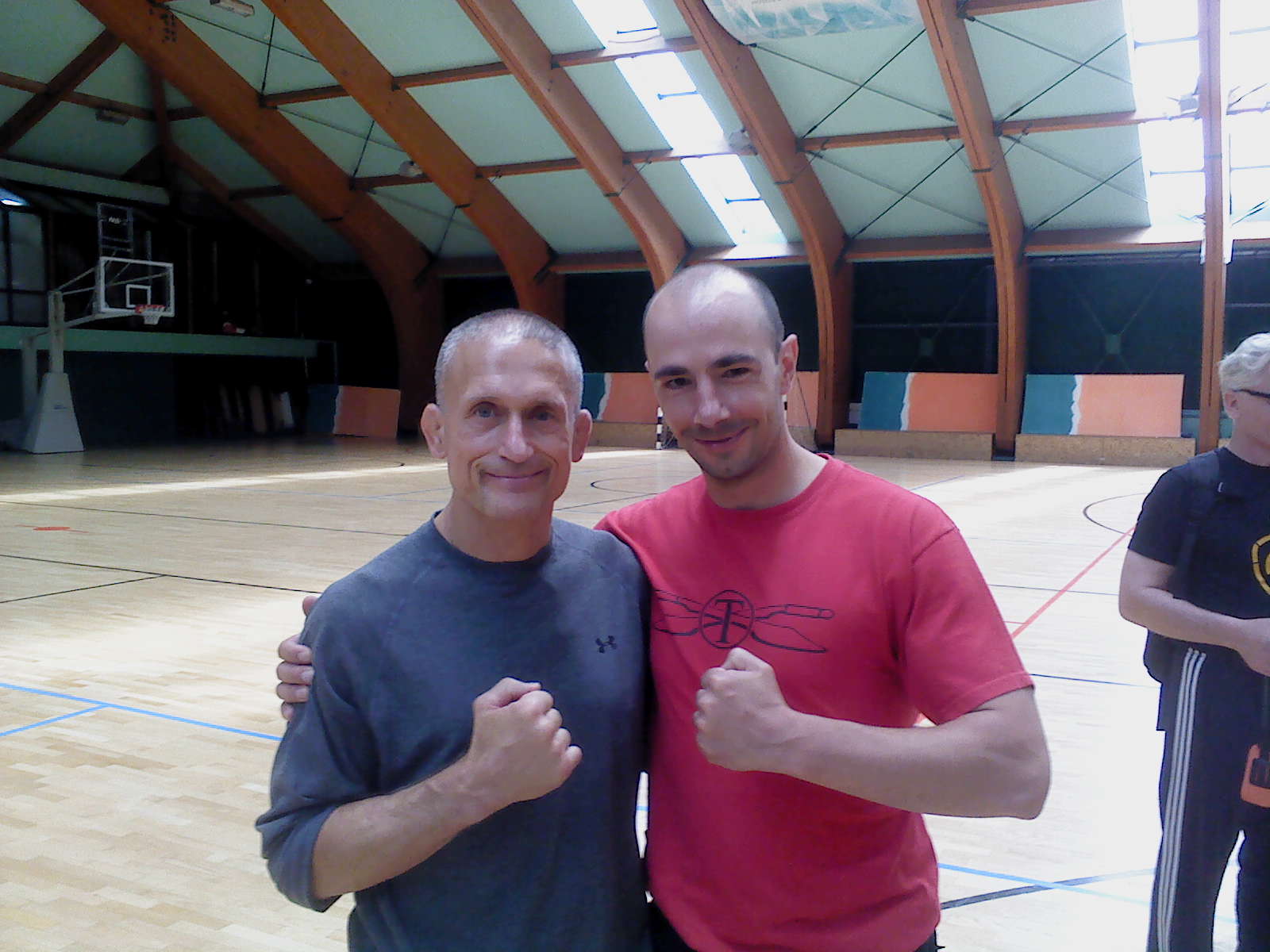
The man (on the left) and the wannabe (on the right)
During those few days, I was further impressed with Steve’s openness and willingness to share, both teaching and learning. A man of 60 years of age, in the physical conditions that puts most 20-year olds to shame, with half a century of training experience and yet, so eager to learn more and new things – even if you learn nothing (highly unlikely), you will be inspired and highly motivated to engage in vigorous physical training.

In conclusion, if you ever have the opportunity to take part in a seminar conducted by Steven Maxwell, do yourself a favor and do it.

Training above the clouds, Mt. Kopaonik, Serbia

This was my 10th time attending this event, and while each and every one was great, this one was special for several reasons. Certainly one of that stood out was the presence and instructional contribution of the guest instructor from Russia, Dmitriy Khakimov. Not too fond of formalities and ego-boosting titles, he insisted on being called Dima, and he came to fill in for his own teacher Andrey Gruntovski, who unfortunately had to undergo a surgery so was unable to come himself.

However, the master certainly knew whom he was sending, as Dima was the absolute hit of this year’s training camp! The school/style he represents is known as Skobar, and it is hard to imagine a better presentation than the one we witnessed for two days. It was very easy to see the direct and true lineage to traditional Russian folk approach to fighting. There many schools of RMA today, claiming lineage that dates back hundreds of years, but with suspiciously modern way of moving and methods of training.

Not so with Skobar. Those in the attendance were able to see and try for themselves the warmups and preparatory moves from folk dances, whipping strikes, pendulum-like body movement, unique footwork designed to work on ice, waved mode of power generation etc. Dima is a phenomenal instructor with excellent sense of measure – he was able to sensibly monitor the mood of the class and switch skillfully from one mode of work to another, thus keeping the trainees motivated, alert and attentive. The material to be taught was chosen adequately, demonstrated and analyzed with care and good pointers, while highlighting the bigger picture and historical context it fits into. 

Dima - small in stature, but a great guy
Like all the other instructors mentioned, Khakimov is an absolute charmer. Always ready to help, join or start the fun, be it singing, dancing, extracurricular stick sparring or having a drink…too bad he was only able to stay for two days. Still, the impression he made was so strong that everybody was left wanting more. That said – stay tuned, we may just as well provide ;-)

Alex Kostic has been the host and the guiding force of this event for years, providing innovative training, brilliant insights and highly motivational environment to train in. This time, it was no different. His take on the mechanics of kicking efficiency and punching effectiveness is ever evolving and improving, so the students always get away with a lot to work and ponder upon after the class. The teaching methodology of Homo Ludens has once again proved successful by seeing almost immediate results even with the people who came to train with close to zero previous training experience.

Alex, the ever evolving martial artist
One of the guys who for sure represent the future of functional martial arts in Serbia, and with bright future before himself, is Stefan Bozic. As talented as they come, hard working and meticulous in his training, Stefan is a true MMA prodigy both as a fighter and instructor. We had the pleasure of learning his approach to the fundamentals of ground grappling, with strong accent on proper body mechanics of moving on the ground, positional control and escapes. Training in the great outdoors can be at the same time humbling and rewarding experience, and it was the case with this session. For the last 15 minutes or so, yours truly provides some insights on the applications of the covered material when having to deal with potentially knife wielding opponent in a ground grappling situation, or being the one trying to deploy the knife when being caught in an inferior position. At the end, everybody was tired but satisfied for testing and feeling on their own the strength of the instruction they had received.

True ground fighting with Stefan
On the last day of the camp, I had the privilege of being asked by Alex to share some of my insights and teach the progression of empty handed defenses against an attacker armed with a knife. Everything I showed was basically a distillation, and sometimes direct application of the things I had learned from my teachers, so there is really no big deal about it. Possibly my “biggest” contribution is the ability to explain the techniques and methods in various ways (most probably the dividends of working as a school teacher for a few years), hence presenting the material to suit the individual learning modes of different trainees. After all, my approach is such that the participants are offered certain guidelines, following basic principles, and then made to play with and discover on their own the strengths and weaknesses of various technical and tactical possibilities. It allows for the dynamic training and quick assessment of the subject matter that was tackled.

In conclusion, I would like to express my heartfelt gratitude to everyone who made this experience possible and as great as it was, including Milan Jerinic for being a great friend and roommate – but special appreciation, beyond words, goes to my beloved wife Mira, without whose understanding and willingness to keep up with my maddening obsession training my life simply would not be even close to being good as it is.