Showing posts with label Homo Ludens. Show all posts

Tuesday, December 5, 2023

Class is in session!

This is a special opportunity! A bit over a year ago Alex Kostic decided to shoot a series of instructional videos (with your truly assisting) to start a Patreon page, but ultimately dropped the idea. However, I talked him into making it available at a nominal fee of $5 per lesson, so that the folks could see the current state of his teaching. 

So, here are the three foundational lessons on structure breaking, as well as defending against kicks and grabs, approximately 10 minutes long each. All the videos are intended for online viewing, and upon payment, you should be redirected to the URL, or receive the link. In case of any problems, message me for the solution. 

KICK DEFENSE


GRAB DEFENSE


STRUCTURE BREAKING 


Besides those, we decided to also offer Alex's first instructional video from almost 20 years ago, which was published on DVD, but has been unavailable for a long time. It is an overview of the scope of training we did at the time, with emphasis on biomechanics of motion and their application over that spectrum. It is a full length vintage value video of 80+ minutes!


In the end, all customers who buy any of these videos by December 12, 2023 will have a 20% discount on the next batch.
Happy holidays! 

Tuesday, December 21, 2021

Kaleidoscopic view

 A week ago I had a great pleasure of being interviewed by guro Tom Edison Pena of the FMA Discussion crew. During the chat, besides an overview of my background and journey in the martial arts, we touched upon several training related subjects. It mostly presents my views about the role of the instructor(s) in conducting the training for the adequate results and with proper approach. 

Some of you may be already familiar with some of the things stated here, but if you would prefer to watch and listen to me go on about various topics, check it out.


Here is a rough outline of the contents:

03.55 - Early beginnings and first steps in MA

14:00 - Physical attributes in technical development

22:05 - Starting RMA and learning perspectives

24:15 - Introduction proper to FMA

29:55 - Encounter with Lameco eskrima and doing long-distance learning

40:20 - Appreciating unpaid instruction

41:10 - Teaching as a learning tool

42:48 - Validity of training approaches

45:03 - Contextual functionalist

47:05 - Stint in MMA; on competition in general

53:30 - Role of luck

56:20 - Alex Zhelezniak and ACT system

57:40 - Teaching/Coaching methodologies

59:40 - Curriculum shortcomings

1:02:50 - Instructors vs Coaches

1:07:00 - Meeting Luis Preto and learning Jogo do Pau

1:11:15 - Tactics as a decision making process

1:12:15 - Mindset foundation for training

1:13:45 - Benefiting from Internet communication

1:18:00 - Importance of cultural and historical background

1:19:30 - Role of "flow" drills

1:23:45 - Forms pros and cons

1:30:50 - Differences between good athletes and coaches

1:33:05 - Sending students elsewhere for their sake or group sake

1:40:54 - Private vs group class

1:41:55 - Some recommended online FMA programs

1:47:54 - Importance of fundamentals and creative application

1:49:57 - Main requirements for teachers/instructors

1:51:35 - Need for education

1:55:40 - Craft before art

1:59:00 - FMA as a community?

Having done the interview, I believe there will be more articles on certain subjects mentioned, because as great as my host was, the boundaries of the format and flow of the conversation didn't necessarily get the fully fair insights into some of those. 

Saturday, June 25, 2016

Digging for nuggets

Every fighting system out there has a certain pool of techniques, some specific, some very similar to those in other systems. Sometimes, the entire difference between two such martial schools is not even the mechanics of their techniques, but rather their application. That said, even within the system there could be more than one possible expressions of a chosen move, hence the emergence of individual practitioners' personal styles.

How does one learn about various possibilities with a particular movement? Obviously, the easiest way is to be shown, by the instructor or a fellow practitioner. The problem with such an approach is that quite frequently those shown applications tend to become the accepted "only true" ones, while other options, even if stumbled upon, are discarded as "not right". That happens to be a common occurrence with interpreting the individual techniques from karate kata. Sometimes two or more practitioners will learn differing bunkai of the same kata, end then sink into the heated debate about whose is the proper one.

The other angle is to do your on research, investigation and experimentation. The advantage of this approach is that the discoveries could be more authentic for the practitioner and better accommodating their personal physical attributes and mental aptitude etc. Also, these are usually better remembered and understood in the long term. The disadvantage, however, is that some people may get lost in the quest for the sheer quantity, thus losing sight of the need to seek the functionally best applications. Well,,,if one is training for the functional goals in the first place.

Namely, a lot of things are possible, but in our training we should do enough drilling and testing to figure out which of those are also more likely and probable.


Take a look at an exercise I did with my friend Daniel from Germany. You'll see that the first move this two-piece combo is treated in the following order:
- as an elbow strike;
- as a punch defense;
- as a grab defense/release. 

Naturally, the effectiveness of each particular application will depend on the proper distance and timing, as those elements are the key factors. Unfortunately, they are often forgotten about, and the problem is sought in improving the mechanics. Sometimes, the mechanics will turn out to be fine, and the technique/application will be discarded undeservedly. 

Certain martial systems have this sort of research as an integral part of their methodology, Such is the example of pecahan in pencak silat, where the sequence of moves is take apart in order to thoroughly analyze its elements, and then put back together with new understanding and new views on what could be done with it. This is the simplified explanation, but you get the gist of it. The following clip of Rita Suwanda offers a nice example. 


To conclude - if you seek a deeper and broader understanding of you chosen discipline, then don;t just take things at their face value. Do your work and be critical about the results, and over time it will bring ripe fruits of your labor. 


Tuesday, July 22, 2014

Sincerity

I have been writing already about the need to discern why are you learning/studying martial arts. But that question does not apply just to the students...If you are teaching martial arts, you have to ask yourself - "Why am I doing this"? What is at all about for you?

See, the thing is, unlike the motives to learn, not every motive to teach is legitimate. And I don't mind people making money from it. No, that is perfectly OK with me, as long as the teacher/instructor is honest about his offer and treats his clientele with due respect. Also, the fact that one may not be charging at all for their instruction does not make them worthy of the teacher title.

My guess is I am not alone in being sick of the types who are looking for some self-aggrandizing experience from teaching, harassing and humiliating their students in the process, all under the excuse of "instilling discipline" or something along those lines. Of course, discipline in itself is not a bad thing, but as long as it is conducive to the better learning and more efficient training process. If, on the other hand, it is a pretense for setting up some sort of unnecessary hierarchy with the sole purpose of blowing the instructor's ego out of proportion and nipping any healthy critical approach and inquisitiveness among the students in the bud... Well, sorry for putting it out bluntly, but then your an asshole and have no business teaching people.

Really? Or is there something more to it...

So what then is the central tenet that "makes it or breaks it" in my opinion? Well, like the title of the post says, it is all about sincerity! And by that I mean the approach to imparting the knowledge on your students.I have been blessed in my martial arts "career" to cross paths and learn from several great teachers, and they all had one thing in common - sincerely doing everything they could to make the student understand and truly learn what they were trying to teach.

Naturally, not all of them have the same teaching methodologies (if they have one in the first place) or philosophy of what they are doing, but they for each and every one of them student comes first! I have seen time and time again Alex Kostic of Homo Ludens Systema inspire awe in people by the way he moves, by the things he says and their eyes going bright for the new insight and another piece of the puzzle finally  falling into place. I have been astonished by Astig Lameco founder, guro Roger Agbulos' ability to captivate the students by the sheer joy of teaching and lighting the fire of desire to train hard and smart, to look for what works and put it all to test. I have been flabbergasted by Mikhail Grudev's managing to overcome the impending linguistic barriers and go out of his way to help the students get the point and have fun while working hard. I have had the privilege of undergoing some intensive training under Jogo do Pau's Luis Preto and admire his keen eye and uncanny capacity to immediately adapt the drill or the exercise to elicit the desired response in the student and make difficult things easier to comprehend.

Quite true
Another high point was seeing master Jon Escudero of LSAI putting his students in the spotlight when demonstrating his system, thus at the same time portraying the effectiveness of the style and his own effectiveness as a teacher. And then there is Steve Maxwell's leading by example and teaching you how to teach yourself; and Daniel Lamac of Koredas eskrima giving it all out without reserve; and Dave Gould of Lameco; Kevin Secours of Combat Systema; Bruno Cancho; Dima Hakimov, and...so on. 

Yes, a good curriculum is helpful, excellent methodology is most welcome. And yet, if you are not teaching for the sake of your students, with no heart in it, but with another agenda that actually has nothing to do with actual teaching...well, do yourself and the world a favor and just leave it.

Wednesday, July 24, 2013

Alex Kostic - ever evolving!

First, sorry for the delay! I did not think it would take me this long to get to this installment…

So, as promised – a word or two about the highlights (for me) of the teaching that Alex Kostic presented during his annual “Training Above the Clouds” event, in June this year.

The main thing you need to know, especially if you have trained with Alex before but not recently, is that currently his focus is almost entirely on the mass fighting scenario in combat. The reasons are multi-fold and not my topic today, but this shift in Alex’s work lead to some interesting observations and conclusions/methods of training. Oh, and a cool new “label” for the whole approach – Wolf Pack Fighting.


Probably the technical chief aspect of fighting multiple adversaries (no tactical layers here! The entire thing is based more on the Russian cultural heritage, i.e. being in a circle of attackers and letting loose[1].) is the specific demand on one’s mode of movement and power generation. Specifically, it means that this kind of highly asymmetrical situation does not allow for the laser-focus approach to maximum technical efficiency and polishing. Instead, you have to move with authority and amplitude, nut not in an entirely haphazard manner.

When being attacked from all over the place and in full speed, there is simply no time to process the incoming information according to a typical OODA  protocol, so you have to act decisively and powerfully. And this is where the principle of individual frame full release comes into play! In short, it refers to making every move count and exude enough power to either knock one of the attackers out or hurt them enough to strike fear and hesitation in coming after you again. As you may have guessed, it does not work in slow motion…

The central mechanical element that makes it possible, and differing largely from most widespread RMA schools today, is the vertical component of all the striking and movement techniques. Namely, this is what will add both power to one’s hits and stability to their movement. That in turn requires loose articulation in the joints, even with short and explosive motions.

Now, while this kind of work may look crude and unpolished to an observer used to highly developed symmetrical combat systems, it dies not mean it is not technical. I took a close look at the people attending the camp, and everybody had to experience all those difficulties and confusion of facing the task of developing a new technical skill. Not to mention the phase of putting the individual moves/frames in succession and stringing them together…and then under pressure of being under the attack of a bunch of people around you!


Speaking of possibly having tried Alex’s work before, the notion of the individual frame full release dovetails really nicely with his punctuated flow concept. The difference is, as I understand it, that the latter relates more to the outer perspective, i.e. how things look when seen from the side, while the former is the “inner description”, or how things feel when done properly.

Last, but not the least, aside from bringing confusion and puzzled experience when learning the moves, the result of doing them in the real time and with full release is a special feeling of exuberance and…well, release. Hard to argue with things you have developed and experienced on your own, even if through the process of guided discovery, as this camp may be described.


[1] Heavily influenced by the traditional Russian martial school of Skobar, headed by Andrei Gruntovski of St. Petersburg

Thursday, November 29, 2012

Lessons learned from teaching

As I got back from Madrid, where I conducted a Systema seminar less than a month after the previous one in Belgium, it was time to summarize the thoughts and conclusions drawn. As I have pointed earlier, for me, teaching is a wonderful learning experience. Especially so when you are able to intersperse regular training in your group/club with occasional seminar or two.

Spanish batch

What seems like the biggest difference in approach is that in one's group it makes more sense to go with a relaxed and not to tightly structured sessions, as knowing the people and feeling their mood allows for a more intuitive approach. It does not mean going with a totally haphazard manner, though. The point is that since the majority of club members are around most of the time (at least they should be), sooner or alter they will be exposed to all parts of the curriculum (if you have one) and learn all the fundamental stuff you have to offer.

In seminars, on the other hand, the presentation must be better structured, no matter the chosen topic, so that the attendees can put thing into perspective. In my case, it means showing the entire (or as much as possible) progression in developing some skill, thus hopefully helping the information retention with the participants. Obviously, it can mean several things.

First, mechanical fundamentals of the skill you are teaching. Preferably, you will do it in a "chronological" manner, i.e. following the logic of "what they need to know first, and then next, etc". For example, blocking an attackers strike with stick with your own will be weak if you do not know how to grip the implement; kicking someone in the head does not make much sense if you do not know how to do a low kick, and so on.

Next, adding the external force to the drill. Essentially it means some form of resistance on either side. In doing a takedown, the opponent will try to prevent the fall; in executing a punch or kick, the partner will be moving... On defense, you may first learn the rolls and breakfalls on your own, to be followed by a partner pushing you.

Finally, add the emotional content. This is a very important aspect, and many people/schools fail to do it. IN line with the above examples, you will be looking for a takedown while the opponent is punching you; same with striking; or instead of being pushed into rolls and falls - you are kicked etc. This is where sparring becomes essential, but it does not stop there, nor is it the only way to achieve the desired outcome.

The bottom line is - train with aliveness (yeah, get acquainted with Matt Thornton's work if you have not so far), but go both symmetrical and asymmetrical with it (read my own previous posts if you have not :-)


Again, back to the class vs. seminar issue. The last mentioned part of the progression is easier to realize in the club setting. simply, in seminars there are way too many factors that have to be taken into account - logistics (protective equipment, space, weapon facsimiles...), matching people's level and experience, monitoring so many people at once, so on and so forth.

Naturally, some domains of fighting are easier to govern as you go further. It is obviously less risky to go run people through the full scope of resistance in grappling then (kick)boxing, wrestling than stick fighting... But that is probably the subject to be discussed at another point in time.

Wednesday, October 17, 2012

Updates and expectations

Later this month I will be conducting a seminar in Belgium, and then another one four weeks later in Spain. It's been a while since I have done seminars abroad, so there are several things I look forward to.

First, seeing some old friends and making new ones. Honestly, at this point of my "career" in martial arts, it is probably the main good thing about going to seminars. Of course, learning something new is always exciting (btw, there is a LOT to learn from teaching such events, if you pay attention), as is seeing new places and trying new cuisines and stuff, but it is the specific energy of the gathering that distinguishes these get-togethers from other communal instances. I guess it is due to the shared passion for something that not too many "ordinary" people understand...

vandenbroeckmarc1@telenet.be

Next,  over the years I have adapted and changed (hopefully grown) as a an instructor, and presenting a seminar is always a nice testing ground for your technical skills and teaching "chops". Getting away from the comfort zone of one's own training group/club provides the new and different energy to work with and plethora of valuable insights. Teaching in a condensed block fashion also requires a different kind of focus and communication approach, so again - fresh perspective on my own understanding of the material. Not to mention the questions coming from the participants...

All in all - I expect have a blast, and promise to share the impressions and some footage with my faithful readers :-)

Wednesday, October 10, 2012

Systema mittology (and lack thereof)


In most martial art circles nowadays, Russian Systema is considered to be from the category of modern systems, although they will sometimes claim centuries old historical roots. Still, even so, the majority of systema schools around the world will also advertise themselves as modern, science-based etc.

Having that in mind, there is one striking feature in the training process in the grand majority of most “classical” schools, and is the conspicuous absence of training equipment involved. Some of the will occasionally reach for some boxing gloves and/or headgear for (rather rare) occurrences of pressure testing (with a few honorable exceptions that make it a regular feature of their programs), but that is pretty much it.

There is a piece of training equipment that is very versatile in it possible applications, that I really fail to fathom how come it is not in common use – a good old-fashioned focus mitt! Sure, striking practice with a live, breathing partner is indispensable, but it does lack in some areas, such as hitting the head, groin area and hard kicks to legs from certain angles for example.

Shapes, colors, sizes...
Another point is, even with punches to the body, one’s progress in developing the power in punches and testing it is more or less limited by their partners’ ability to take those same hits, especially in dynamic circumstances and drilling on the move. Again, some sort of striking target offers a quick remedy for those impediments.


Ok, in this clip we see the trainees working punching combos on focus mitts. The catch is that they are working from a kneeling position on the ground, as it forces them to really work the mechanics of punching that relate primarily to the upper body, since they cannot “dig in” hard and push from the feet. Also, it aims to open their mind in view of all the options of WHEN to strike, i.e. not missing the opportunity to hit a good target just because you’re not in your most comfortable zone.

It kinda lays the foundation (well, at least one aspect of it) for the next type of drill.


Here, the trainee is instructed to hit the target as often as possible in a more chaotic situation. Namely, the third participant works on his or her structure breaking options and takedowns, while the striker does not oppose it. Instead, they have to go with the flow, engage the ground as subtly as possible and get up again immediately, while striking the mitt at all times and from any position.

This one would be much harder to do safely with targeting people, especially if also trying to hit with some tangible force. Again, while it is necessary to be hitting people (and get used to being hit as well), there is nothing wrong with making things more “fun” with the simple introduction of some simple equipment.

p.s.
The prevailing majority of guys in the videos are beginner with 1-3 months of training experience, so don’t be too harsh in judging their performance ;-) 

Saturday, June 16, 2012

Seminar frenzy


The first half of June was my vacation time, and man, was it rock ‘n ‘roll! So much training and so many seminars in only two weeks give the true meaning to the phrase “active vacation”. Let’s go in a chronological manner…

Lameco Astig Combatives in Holland

On June 1 I flew to Amsterdam for a seminar with guro Roger Agbulos, with whom you should be familiar by now. The seminar was set for Saturday, but I met with guro Roger and his wife Rosie, as well as a new friend Jojo Balinado, the day before. After having the dinner together, we all moved to kuya Roger’s hotel room to talk martial arts, and even have a training session.

Bothering guro Roger with questions :-)
On Saturday we headed off for the seminar, held in Leiderdorp and hosted by William Paardekooper in his Kapap Center. With participants from Germany and Holland, along with yours truly, everything was ready to go.

Guro Roger opened up with his take on empty-handed defense against knife, with special emphasis on sound physics of the techniques shown and on the functionality over aesthetics. The control of the opponent’s knife hand and ways to deal with it was a novelty to me, and it made so much sense that included it immediately in my own training, including the modifications to the methods I had been already practicing and found reliable.

Holdup!
Next, we moved to knife vs. knife work. Again, adamant about functional skills, drills and their applications. Guro Roger covered both forward and reverse/ice-pick grips, and without going into too much details (hard to convey in writing anyway), I will just say that his mode of working the hubud drills has reinstalled my belief in that sort of training, and made me go back to doing it regularly.

Finally, the focus was shifted to working with the stick and its essential qualities – power mechanics, non-telegraphing hitting, distance control and merging the defense with offense. This segment of work, just like the knife, was complemented with sparring sessions, in order to appreciate the functionality of the material demonstrated. Being on the receiving end of guro Roger’s attacks leaves one with mixed feelings – being overwhelmed and inspired at the same time.

Besides being an awesome instructor, guro Roger also has incredibly pleasant personality and a great sense of humor, so I am most definitely looking forward to the next opportunity to train in Lameco Astig methods with the founder himself.

Physical preparation for fighters in Belgrade, Serbia

Among the people who are seriously involved with functional fitness and training for fighting, the name of Steven Maxwell is a household name. On June 7, I had the opportunity to partake in his seminar in Serbia.

The event was somewhat of the surprise and organized as a last-minute kind of thing, but still great. Mr. Maxwell covered a lot of ground and touched upon many topics, ranging from joint mobility, through proper mechanics and variations on common bodyweight exercises, to fight preparation, overtraining and some kettlebell training guidelines.

Working it out
Maybe not everybody got everything they hoped for during this seminar, but if you are something of a training nerd that I am, and did you homework previously, it was a splendid chance to have some dilemmas solved and find a lot of pieces falling into place, regarding the bigger picture.

Being the interpreter for this seminar, I was very glad to interact with the man and enjoy his warm and approachable personality and tireless dedication to teaching. This only reinforced my eagerness to further communicate with Mr. Maxwell for a few more days, as he joined us at our annual training camp that followed (and is briefly reported on next). For me, it meant learning more – proper lifting technique, ways to break through plateaus – and experiencing his world-class BJJ…as well as being privileged to be called “man among men” by such a formidable guy, even if jokingly :-)

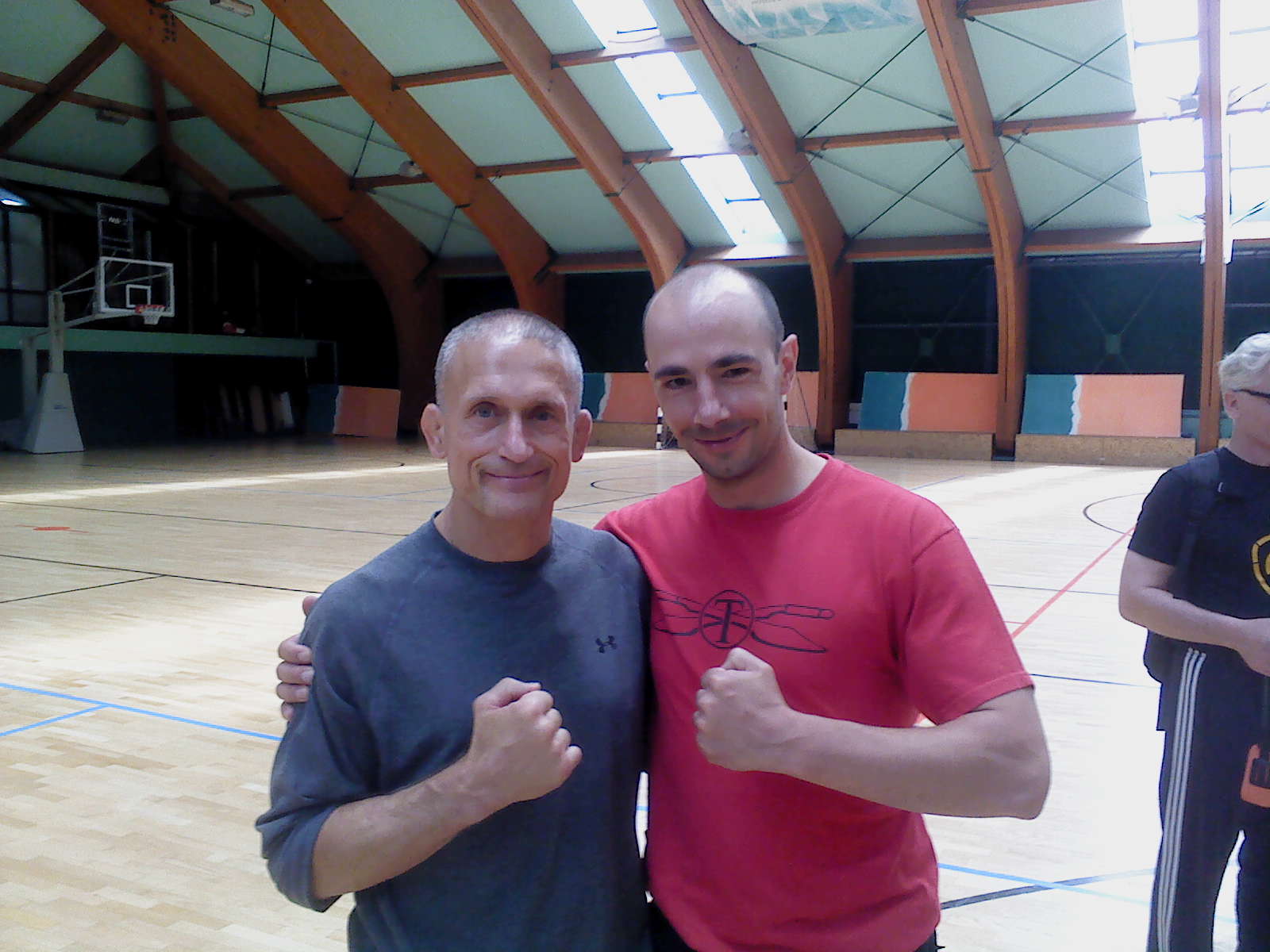
The man (on the left) and the wannabe (on the right)
During those few days, I was further impressed with Steve’s openness and willingness to share, both teaching and learning. A man of 60 years of age, in the physical conditions that puts most 20-year olds to shame, with half a century of training experience and yet, so eager to learn more and new things – even if you learn nothing (highly unlikely), you will be inspired and highly motivated to engage in vigorous physical training.

In conclusion, if you ever have the opportunity to take part in a seminar conducted by Steven Maxwell, do yourself a favor and do it.

Training above the clouds, Mt. Kopaonik, Serbia

This was my 10th time attending this event, and while each and every one was great, this one was special for several reasons. Certainly one of that stood out was the presence and instructional contribution of the guest instructor from Russia, Dmitriy Khakimov. Not too fond of formalities and ego-boosting titles, he insisted on being called Dima, and he came to fill in for his own teacher Andrey Gruntovski, who unfortunately had to undergo a surgery so was unable to come himself.

However, the master certainly knew whom he was sending, as Dima was the absolute hit of this year’s training camp! The school/style he represents is known as Skobar, and it is hard to imagine a better presentation than the one we witnessed for two days. It was very easy to see the direct and true lineage to traditional Russian folk approach to fighting. There many schools of RMA today, claiming lineage that dates back hundreds of years, but with suspiciously modern way of moving and methods of training.

Not so with Skobar. Those in the attendance were able to see and try for themselves the warmups and preparatory moves from folk dances, whipping strikes, pendulum-like body movement, unique footwork designed to work on ice, waved mode of power generation etc. Dima is a phenomenal instructor with excellent sense of measure – he was able to sensibly monitor the mood of the class and switch skillfully from one mode of work to another, thus keeping the trainees motivated, alert and attentive. The material to be taught was chosen adequately, demonstrated and analyzed with care and good pointers, while highlighting the bigger picture and historical context it fits into. 

Dima - small in stature, but a great guy
Like all the other instructors mentioned, Khakimov is an absolute charmer. Always ready to help, join or start the fun, be it singing, dancing, extracurricular stick sparring or having a drink…too bad he was only able to stay for two days. Still, the impression he made was so strong that everybody was left wanting more. That said – stay tuned, we may just as well provide ;-)

Alex Kostic has been the host and the guiding force of this event for years, providing innovative training, brilliant insights and highly motivational environment to train in. This time, it was no different. His take on the mechanics of kicking efficiency and punching effectiveness is ever evolving and improving, so the students always get away with a lot to work and ponder upon after the class. The teaching methodology of Homo Ludens has once again proved successful by seeing almost immediate results even with the people who came to train with close to zero previous training experience.

Alex, the ever evolving martial artist
One of the guys who for sure represent the future of functional martial arts in Serbia, and with bright future before himself, is Stefan Bozic. As talented as they come, hard working and meticulous in his training, Stefan is a true MMA prodigy both as a fighter and instructor. We had the pleasure of learning his approach to the fundamentals of ground grappling, with strong accent on proper body mechanics of moving on the ground, positional control and escapes. Training in the great outdoors can be at the same time humbling and rewarding experience, and it was the case with this session. For the last 15 minutes or so, yours truly provides some insights on the applications of the covered material when having to deal with potentially knife wielding opponent in a ground grappling situation, or being the one trying to deploy the knife when being caught in an inferior position. At the end, everybody was tired but satisfied for testing and feeling on their own the strength of the instruction they had received.

True ground fighting with Stefan
On the last day of the camp, I had the privilege of being asked by Alex to share some of my insights and teach the progression of empty handed defenses against an attacker armed with a knife. Everything I showed was basically a distillation, and sometimes direct application of the things I had learned from my teachers, so there is really no big deal about it. Possibly my “biggest” contribution is the ability to explain the techniques and methods in various ways (most probably the dividends of working as a school teacher for a few years), hence presenting the material to suit the individual learning modes of different trainees. After all, my approach is such that the participants are offered certain guidelines, following basic principles, and then made to play with and discover on their own the strengths and weaknesses of various technical and tactical possibilities. It allows for the dynamic training and quick assessment of the subject matter that was tackled.

In conclusion, I would like to express my heartfelt gratitude to everyone who made this experience possible and as great as it was, including Milan Jerinic for being a great friend and roommate – but special appreciation, beyond words, goes to my beloved wife Mira, without whose understanding and willingness to keep up with my maddening obsession training my life simply would not be even close to being good as it is. 


Thursday, May 10, 2012

Curriculum in Russian martial arts - our take


My friend Paul Genge, a RMA instructor from UK, has recently written about the place and role of curriculum in training this type of combat methods, and what shape it should take. (For Paul’s very good and insightful article, go here: http://combatlab.russianmartialart.org.uk/blog.asp?blogid=2 )
This post is my attempt at offering some guidelines in that regard. It needs to be clear right away, that the following methodology of teaching and training in RMA is not my own breakthrough, but rather the accumulation of knowledge and experience that has been embodied into what is now known as HomoLudens approach to martial arts, coming from the instructors in the club Vukovi (Wolves), with whom I have had the pleasure and privilege to work.

The first thing should be sorted out is what is the main focus of teaching? Is it on passing some specific body of knowledge in a more or less intact form, or is it making the students, as individuals, capable to express a degree of fighting competence in their own performance, and naturally, with their own individual style. We happen to be inclined towards the latter, which in turn dictates certain “progression”, or maybe it is better said hierarchy of things. The first issue is somewhat based in our integrity as a club – we teach what we believe the student NEEDS to know, not what they WANT to know! So far, it has pushed away many a Specnaz wannabe and Youtube “warrior”, who were focused on the image of things, over the substance. While maybe not the best business policy, the Wolves refuse to be feeding people’s illusions for mere monetary profit, and instead we offer an honest and authentic environment to train in.

HomoLudens club Vukovi

OK, so what is it that a student of (Russian) martial art needs? I guess there are as many answers to this question as there are instructors. The viewpoint also plays a significant role here – is it dealing with common types of attacks; mastering some “high percentage, surefire” techniques; having ready-made answers to wide variety of problems etc.

Our starting point is the bodily ability to deal with certain physical realities, pertaining to combat. Yes, those are many, but some fundamental ones are: free movement in space, comfort in any plane and any level of movement (standing, kneeling, squatting, sitting, laying and anything in between), handling the force of the opponent, issuing force of our own, emotional composure in dealing with all of the above.

Now that the needs have been identified, one can work on learning about the best way to execute those movements, i.e. the proper mechanics of delivery, and then honing and polishing them. Here we come to a couple more important points to cover. One is that our teaching, like in most other RMA schools, is based on the emphasis of principles over prescribed techniques. That does not mean, of course, that techniques are unimportant and irrelevant, far from it. Everybody needs techniques that best illustrate the principles that form the core of a training method…however, a technique is but one possible expression of a principle and should be taken as such. Therefore, the drills are meant to instill the command of a principle, not to build the “automatism” of a technique. It means that as soon as the student gets a grasp over the principle, he is exposed to the dynamic, fuzzy type of drilling, where his technical expression will have to adapt “on the go”, in effort to properly respond to the demands of the situation.

Think of it as the conversational scenario when taking a course of a foreign language. You do not practice your grammar by “drilling” the same sentence over and over…at least I hope you don’t.

Speaking fluently?

What you take a look at it, there is a sort of dichotomy here – on one side you need to develop good and efficient mechanics of delivery; on the other you need to be able of adjust it to the context at hand. The former focuses on technical precision, the latter on the emotional composure that enables the adaptation. How do we put the two together?

This is where the great insight of HomoLudens founder Alex Kostic comes in handy again, i.e. his formula of symmetrical and asymmetrical “work” in fighting. I have already discussed this distinction before, so let me go straight to how it applies here. We use the symmetrical approach to developing and refining the mechanical efficiency and technical precision, while the asymmetrical work is employed in enhancing the contextual adaptability, along with its emotional/mental component.

Alex Kostic

If we are to get back to that language learning metaphor, the symmetrical approach is building your vocabulary and grammar, the asymmetrical is becoming conversational – thinking in a foreign language, without the need to translate every single sentence in your head.