Okay, this fill be the final post (think of it as a het-trick) on the role of awareness and alertness in the grand scheme of personal protection...for now at least. The previous two articles touched upon some of the basic tenets of what is desirable and what is not in that regard. This time I'd like to point you to a great source for further study.
David W I Wilson's work From The Base Up! is a fairly recent book, and a pretty damn good one if I may say! From the very beginning, it is absolutely thrilling to see aa book whose cover page lets you know exactly what to expect. Specifically, taken together its title and subtitle - Building foundational skills for situational awareness, strategy, and self-defense - very aptly describe what the content is all about.
The aspect of this piece of work that makes me like it so much is that the author gives a very comprehensive, yet practical overview of what is a rather complex subject. He approaches the presentation from several angles, addressing the building elements of situational awareness, strategy and goals, willpower, context, tactics, force matrix, intent, structure, breathing, efficiency of motion, effectiveness, as well as practical application beyond combat. As you can see, it is an integrative approach that includes both "software" and "hardware" skills and discusses how they work together in striving for the optimal outcome.
Remember how I said it was practical? Well, that is possible the strongest feature of Wilson's book. Whereas most other works on this topic tend to stay in the predominantly theoretical domain, spanning from the unnecessarily burdened neuropsychological treatises to cheap lip service pamphlets that boil down to "trust your gut" level of advice, From The Base Up actually deliver a well laid out progression of explanations, accompanied by actionable steps. It means the reader is given concrete advice and various exercises to better absorb the content, i.e. make the material useful in the real life.
Now, be aware (excuse teh pun) that it is still not what most people would consider a handbook, because the subject matter is highly intangible and dependent on the user's individual circumstances and needs. However, it is exactly this that makes Wilson's book impressive - to my mind he hits the sweet spot between the education (underlying theoretical principles) and instruction (the practical drills/exercises), so that the readers who take it seriously could reap benefits that reach beyond instant solutions to problems they may not even have.
Ultimately, a good understanding and "embodiment" of the material presented should make one much better equipped to recognize, prevent, avoid and/or manage all kinds of conflict situations in such a way to also prevent and avoid as many of the negative consequences (psychological, physical, social, legal...) as possible.
With that in mind, it is hard to imagine a better investment in one's personal safety.
On the track of the previous post, which dealt with the importance of situational awareness in personal safety, there is something I need to point out. In that post I mentioned OODA loop as a decision making model, and there is ONE single question you may ask yourself that could totally throw your loop off and gravely diminish your chances of an effective response in a bad situation.
It is somewhat ironic that at issue (or the issue as it may be) is the same question I have repeatedly stressed as possibly the most important one to ask in your training - WHY?
Hmmm, how come? Well, please note in the previous paragraf that the description of the question is based on its importance in training. And there is a huge difference between training and acting in application. Namely, the process of training is meant to help in developing desirable attributes and skills that would ultimately increase one's chances of adequate performance in a moment of truths, whatever that may be for a given person (a competition match or tournament for athletes, mission for soldiers, assignment for LEOs...or responding to an assault for civilians). So, in order to ensure that our training is going in the right direction, it needs to be constantly analyzed and reviewed, with the goal of improving its effectiveness and efficiency in that regard.
However, if or when you have to face the unfortunate situation of needing to deal with an attacker intent on inflicting you harm, the one thing you should not ask is "Why is this happening to me?". i.e. "Why is he/she/they doing it?" or any of the variations on the theme. You see, at that point, even if you found the answer to the question, it would not be helpful in any way to solving the problem. You need to act as decisively as possible, so the questions that would be more helpful are what to do and how to do it. And hopefully, the training has already provided those answers and equipped you with proper tools for the implementation of responses.
That said, there is the right time to ask that pesky WHY even when it comes to life threatening situation, which are best avoided (again, see my previous post), and that is either before or after the event, but certainly not during. Prior to the event is what is called preparation, in hope of getting some understanding of the phenomenon and raising the level of your readiness. Understanding violence and your place in it from this standpoint may be helped by some good works from Rory Miller (Meditations on Violence) Marc MacYoung, Varg Freeborn, Tom Sotisetc. In the aftermath of the event it is first and foremost the time to deal with any physical, legal and psychological consequences that may stem from it. Along the way you will possibly want to asking those WHYs, in order to do your best in attempt to avoid similar situations in the future or at least improving your chances of better dealing with them.
Mind you, it is not an easy process and there are rarely completely clear and fully dependable answers, but as always...it is about increasing your odds.
As the year comes to its end, I've been reminded of several instances of real life threats, incidents, attacks, i.e. personal safety threats caught on video and circulated on the internet. In most cases the attacks were successful primarily due to the element of surprise, as they came unexpectedly and caught the victim(s) totally unprepared. It completely skewed their OODA look (do some research if you don't know what it is) and tipped the situation in attacker's favor. The victims' thought process was typically paralyzed (more about the wrong questioning in the next post), thus further impairing their ability to react.
So, succinctly put, the main problem was the lack of situational awareness by the victims. In the personal protection circles it is one of the pillars of effective (re)action and often mentioned, albeit not always explained in detail. I won't go into it deeply either, but let's see what are its main components.
We see that the first phase of developing good awareness is to track what is going on in our surroundings. It effectively means not going around in the "autopilot mode", and instead be present in the given moment. That does not mean paranoid, but actually involved in perceiving what is going on in the overall sense. Essentially, it is like driving during rush hour - yous can't allow yourself to doze off, but no need for super focused, nerve taxing attention either. After all it is (still) not a NASCAR of F1 race.
The next component is comprised of comparing the info received against the background of habitual baseline that we have for a given time and place, in order to establish whether the situation is somehow deviating. If not - just carry on; if yes - how is it deviating and does it require more concern.
Finally, in the case of relevant concerns, we ought to make general predictions of how the situation may unfold and decide on appropriate action, should our predictions show to be true. Namely, this accelerates the action, if the push comes to shove, as they say.
By the way, this is also the summary of the above mentioned OODA (observe, orient, decide, act) loop.
OK, now you have the basic idea. However, as it is always the case, in order to ingrain this knowledge into a useful habit, some practice is needed. This is, of course, a subject that can be treated in depth, but let us get at least a basic start.
The main thing is to break out of the bad habits and harmful state of mind, such as being lost in phone conversations, email correspondence or mindless scrolling when on the go. To get the ball rolling, give yourself an assignment next ime you are in public transport or walking the streets, especially the routs you know well, as those are typically where our autopilot takes over. For example, make sure to note all the people who wear a hat, or a scarf, or a piece of clothing of a predetermined color. Next, strive to pick up certain actions, e.g. moving with hands in pockets or unusually quickly, against the crowd, too slowly, looking lost etc. Don't neglect your hearing either - try to identify some type of sound! Can you differentiate between the sound of a passing bus, truck, motorcycle, car? Sounds coming from a construction site or a school yard?
The point is not to try and do it all at once, especially if "waking up" after a long "sleep". Take one step at the time, spend a couple of days at each assignment and things will gain momentum soon enough.
Now, this reminds me of a comment I read from Terry Trahan (founder of WeaselCraft, check him out): in order to develop good situational awareness, you need to have some environmental awareness first! It means going back to that baseline we mentioned before, i.e. knowing what kind of general social behavior is normal for a given place or space. What might be normal or acceptable in a park or on he playground may sound your alarm in a workplace. As a matter of fact, the normal overall atmosphere could differ radically between two establishments of the same purpose, but in different places, e.g. a bar in the blue-collar part of town during the home game of the local sports club on weekends, and the fancy restaurant in the business area during lunch time mid-week. You get the idea...
Being aware of those factors and attuned to your environment, with appropriate state of mind (do a quick search for Cooper's color code of awareness) should ideally prevent the situation from turning really bad in the first place, or at the very least prevent you from finding yourself freeze as the proverbial deer in the headlights.
Take the step in the right direction and help the new year be good to you!
Sometimes I can't help noticing that we live in a world where everything is quantified, so the notions of success and achievement are based on measurements, typically in an attempt to be (quasi)scientific in one's approach to training. While such a view has some value in certain domains, particularly in a professional sport field, I believe that in some other practices it might be (at least occasionally) harmful.
Even in a very streamlined sport of weight lifting, for example, there are so many factors involved (sleep, mood, state of health etc.) that it would be ill-advised to focus on the numbers as the sole indicator of progress. More than once have I seen a lifter miserable after a good session, because they failed to reach a goal that was a number on the paper (or the screen). How do you quantify quality or pleasure?
Things get even more complex in an oppositional skill based arena that is martial arts and combat sports. For a lot of people involved in these, there is this idea of making progress by "getting to the next level", which entails learning advanced techniques and/or more new maneuvers. You see it everywhere, from the modern BJJ and MMA gyms and their new tricks of the trade, to the traditional schools, where the new belt means new forms and techniques. We always strive to get to a new step and climb higher on the chosen ladder of success.
But what if that is a wrong viewpoint? After all, they say that advanced techniques are the basics done really well, right? Wouldn't that mean we ought to get deeper, not higher? Hey, even the Earth's structure prefers depths to heights!
So, let me try and provide some answers to the above questions. I happen to be a proponent of the basics done well school of thought, because the concept of deep skill is the foundation for the execution of advanced tactics and strategies. In other words, with an excellent command of a finite set of skills/techniques, one has the confidence and cognitive resources to use them in solving the changing demands of a dynamic combative situation. A classic example may be the legendary Bill "Superfoot" Wallace, who decided to train his kicking techniques only with the left foot, but make it so good that his opponents had difficulties dealing with it, despite knowing what to expect. Or Rickson Gracie rolling each participant in a seminar and submitting them all with the same technique!
Therefore, with a proper learning and training process it is possible to develop required attributes, thus being able to overcome most challenges faced in the process of training and/or application. I know, we are constantly exposed to so much novelties in training and bombarded with all kinds of (dis)information, so it can be really hard to keep it at bay while maintaining focus. Yet, we are often reminded that "Jack of all trades is a master of none..."
"...but often better than the master of one!", however! Wait, what? Aren't I contradicting myself? Well, not really. See, IMHO, one needs to be a comprehensivist in terms of areas of competence, but then a deep diver in each of them. Naturally, the number of those areas of competence will depend on your purpose in training - sport, cultural study, recreation etc. Let's say you are a MMA practitioner with competitive inclination: you would need to develop some functional skillset in standup/striking range, clinch/wrestling and the ground/grappling game. Now, if you have previous background in one of the disciplines that are typically perceived as "main ingredients" of MMA (i.e. (kick/Thai)boxing, wrestling, judo, sambo, BJJ), it could be possible and maybe even recommended to build a strategic approach of taking the fight to your area of expertise, with solid defense in all the others.
Let's see what the deep dive consist of, then. The first thing would be to identify a finite set of techniques and tactics that make the functional foundation within that area and then work on truly internalizing and integrating them, to a degree that we could improvise and play with them at will. For example: in the standup game - jab, cross, front hook, low kick and (maybe) front kick, corresponding parries and defenses; in the clinch game - a couple of controls and takedown from wrestling (underhook, weezer, single leg), head/neck control and a couple of elbow and knee strikes from Thai-boxing, takedown defense/sprawl; on the ground - essential positional control, 2-3 escapes for each position, 2-3 submissions from each position, a couple of fundamental sweeps/reversals, and fundamental ground and pound options.
Huh, it is still quite a bit... But, if you get deeply skilled in those, there will almost certainly be no need for jumping or spinning kicks and backfists, scissor throws and suplexes, berimbolos and lasso guard or calf slicers. Leave those to the folks specializing (i.e. deep diving) in those singular disciplines.
If your aim is on the pavement arena of self-protection, you will also want to address hand held weapons (impact and edged...firearms if it fits your legal environment), with emphasis on access and deployment, along with a couple of low-risk and effective techniques/strikes, while discarding the twirling and flipping stuff. (There are quite a few reviews of the applicable instructional volumes on this blog). When it comes to defense, focus on control over disarming. While on the subject of street self-defense, if you try running a couple of scenarios that involve multiple attackers, it will quickly become obvious which physical techniques and tactics are to be prioritized (footwork, standing wrestling, straight punches, low line kicking).
Thanks to the easy access to video footage of all kinds of physical situations, it is relatively easy to figure out what are the technical and tactical tools that should be prioritized, so-called high percentage ones, in order to avoid straying away from your training mission.
Seriously... From the legal perspective, what kind of personal weapon, suited for self defense is the easiest to obtain and least hassle to have at home or in the car? Definitely some kind of daily use tool. Basically, it really boils down to screwdrivers and hammers. After giving it some thought, analysis and experimentation, I tend to favorize the latter option. While the screwdriver is definitely easier and less conspicuous to carry around, and even a lot of the knife material presented on this blog is easier to adapt to it, from the perspective of home defense one thing seriously stood out as hammer's advantage - stopping power! Think having to face an attacker who is carrying a knife or a machete...which would you rather have in such a situation? After all, in a tool vs. tool "duel", would you rather be a person with a screwdriver or a hammer?
As a support to that argument, take a look at the following video at around 00:10 and 00:30 to see who is backing away from whom. (WARNING: you may need to log in due to the violent nature of the footage)
So, if we settle on the hammer, one may naturally wonder how to approach its use. Well, depending on the size and weight of the tool, you can't go wrong with using any of the tomahawk instructionals I have featured earlier. It should give you a pretty good foundation in understanding the dynamics and control of the weapon. Both will inflict a lot of impact trauma with a good potential to quickly end the situation.
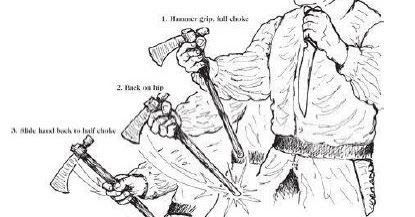
That said, there are further options of use, for example if we have to act in a confined space or other circumstances, and in order to investigate, I suggest you try some of the handling grips I find to be practical.
standard
When other weapons are held in this manner it is called a hammer grip, so that tells you something. Also, most of us are already used to it, so that is a good place to start, especially from the perspective of those tomahawk approaches. with this one, it develops most power, but it is accompanied with most inertia too, in case of missing the target. Therefore, proceed with caution in your training - go slow and with control, thus avoiding injuries and damage to unsuspecting furniture etc. I had bumps and dents in the wall to prove it.
full choke
Moving the grip from the end of the handle toward the "business end" of the hammer is called choking, so the above grip is considered a full choke. It enables a much swifter maneuvering and less impact on the wielders elbow and shoulder joints. I find this neat because it doesn't take much to adapt a lot of punches to be used (boxing jabs, crosses, hooks and uppercuts all can be made to work fine), while the handle can easily be employed in manner taught by most reverse grip knife systems (search for "reverse grip" on this blog). The main shortcoming is a shorter reach than with the previous grip.
inverted/reverse
This one may not come naturally, but has shown to be quite useful. Again, most punching techniques are easily applied here, and the term hammerfist gets its true meaning with it. Now the handle can be used as a short club, so any experience with sticks and other impact weapons should be easy enough to implement. Again, the shorter reach may be a disadvantage (or not), and it turns out that if you are not careful, it is easy to hit yourself with the tip of the handle when doing hooks or some other moves. Ouch!
"concealed"
Probably the most unusual way of handling here. The term "concealed" isn't exactly adequate (hence the quotation marks), but it is the least conspicuous when standing in a natural stance. Be as it may, the advantages here are that almost any punching technique can be used, because the head of the hammer acts as a fistload, while the handle does not get in a way, if you experiment with the exact position a little bit. As a matter of fact, it comes in handy as a defensive tool/shield against slashing attacks with knives, sticks and other implements. This is, possibly, the fastest of these grips, but not suitable for all shapes and sizes of the tool.
Could it be a wrench? Well...yeah. In all honesty, though, I don't find it as widely applicable and easy to use. Don't let it deter you, however, experiment for yourself. Hope this gave you some inspiration, and maybe I will post some more technical stuff in the future.
Nobody likes getting bad news, even when they are not directly related to themselves. Sometimes such news wake up and put to the forefront those hard questions that we often seek to ignore or sweep under the proverbial rug. This time, it was the report of BJJ and MMA legend Rickson Gracie being diagnosed with Parkinson's disease. And being that in this regard he joins other legends in the domain of combat activities, most notably Muhammad Ali, but other greats such as Freddy Roach as well, it made one of "those" questions resurface again...
I learned about this case via a report/commentary by Rodney King, who has already been featured a couple of times on this blog. His view of the situation (as shared on Facebook) is sobering because he also speaks from his own experience, which clearly shows that at issue is not an isolated case, or even a string of unrelated cases. These facts make the above question that much more uncomfortable to ponder.
If take a stroll through my older posts, you will easily find out that dealing with injuries is one of the topics that are taken as important here, because they have at least a two-fold harmful effect - inhibiting further training; and essentially attaining a counter effect to that training, i.e. they makes us more vulnerable that being healthy and untrained. But, those are just the physical injuries. As a matter of fact, with regards to martial arts and combative training, if taken from the functional fighting perspective, they come with the territory, as a manner of speaking. Even when growing into chronic issues, such as arthritis, rheumatism etc, I am frequently inclined to think that it is worth the benefits one can reap from training.
However, the neurological problems and conditions that may stem from them are a different can of worms. First, there is a huge quantitative difference in terms of the deterioration in quality of life, between various orthopedic issues on the one side and Parkinson's, Alzheimer's, or ALS on the other. The degree of a person's functionality in living their lives is simply beyond comparison. Second, and directly connected to the last comment, is how it affects our immediate social environment, i.e. the closest family and friends. Exactly...all of a sudden we don't just bear the responsibility for ourselves, as you can't simply say "it's my life". Because it is someone else's too.
So, how do we tackle the problem? How does one stay active within his or her chosen field, especially when it is a true passion, while being more responsible in a long-term? Is it even possible to train in a way that is simultaneously geared toward functional effectiveness and personal preservation? The easy answer is - yes! But it is necessarily simple to achieve. Namely, there are many factors at work here, and a proper training environment needs to juggle many of them at any given moment. But that fact is by no means an excuse to neglect it.
The solution probably boils down to a good training methodology, depending on an individual's motives for and needs in the learning/training process. In your search for the good foundation, you might even start with some of the articles on this blog, and see how those suggestions apply to your current training situation. Or, you could go and consult any of those resources from Rodney King, because he has literally dedicated decades of his life and work to developing a paradigm that would successfully avoid or solve the problem we are discussing.
Ultimately, from this perspective, it is not so much the question of what you do in your practice, but rather how you do it. Therefore, should you choose to keep following the same road, at least try to do it in the best vehicle available.
What category of students is the hardest to teach? Yeah, as always, the answers depends on many factors, such as what are we teaching; for which purpose; in what circumstances; how often and for how long etc? Still, even with all these things in mind, I would probably not think of children as the immediate answer... Probably not even in the Top5.
You see, I work as a schoolteacher in secondary/middle school, but used to work with elementary pupils, too. As a matter of fact, for a couple of years I even taught the physical education class and was given carte blanche to include martial arts in those classes. And it was always enjoyable for everyone involved! In all honesty, though, the whole point of those sessions was to be fun, provide some new movement patterns, keep the kids' attention to teach them focus etc. With goals like that, working with children can be a really rewarding experience. And I do truly believe that martial arts can be fantastic tool in building those kids to be better members of the society, under the guidance of good instructors.
However, in a recent conversation with a mother of K-6 child, and myself a father of a 13-year old, I was asked what was the proper response to school bullying. And I couldn't give a good answer. You see, the local situation here has changed dramatically in the past month. Less than three weeks ago we had a first ever school shooting, nine kids and one adult killed, a few more wounded. Something that previously had only been stuff of unbelievable news from over the Atlantic. And it caused an avalanche of escalated school violence of a degree unheard of around here.
And everyone was dumbfounded... Institutionally (schools, judiciary, media etc), and on the individual level (parents, teachers, children). The thing is, it has been a tough issue for a while now. And here is why.
Namely, just like in the world of adults, any act of physical altercation could have consequences on several levels - physical (injury), emotional (trauma and stress), legal (kids in schools, parents potentially in court), social (how will other kids and families react). The main difficulty, then, lies in actually teaching all that to a pre-teen or even teenagers. Not even adults are always able to handle all those dimensions successfully, if at all, often because it involves too much time and effort (in their view) needed to gat a handle on it.
The children, on the other hand, are often readier to learn but lack faculties in understanding the deeply interleaved nature of all the aforementioned factors. Heck, at that age they are unable to perceive most anything in terms of long-term views. Patience, attention span, commitment - those are all challenges that can be tackled; but social awareness, understanding of consequences, liability, finality of some deeds - pretty much insurmountable obstacles. At least in this culture.
Do you teach a bullied child to stand their ground, without knowing how the bully will react? What if he or she pulls a knife or comes with gun next day? Hell, what if they come with an older criminal sibling or parent? At this point, we are moving from self defense to self preservation!
Do you tell them to report to school authorities and rely on their solutions? Yeah, right. Or maybe not even report at all? Do you teach the bullied kid to be first in escalation, use a knife? Join a gang? I hope you didn't even thing of the last two...
If we have hard times dealing with these questions as parents and potentially instructors, how could we expect children who haven't yet fully developed their psychological and physiological faculties to get a grasp of it all? The answer is - we cannot, and they shouldn't!
What we have at hand is a cultural phenomenon where the society is not really a community, and folks turn their heads away from other people's problems...until they become everybody's problems. Well, that kind of problem demands much more macro-level solutions, and we all ought to take a deep, hard look into our own contribution to the problem and our possibility of contributing to the solution.
When I first got interested in knife related combative issues, back in mid-90's, there were few printed resources available, and not all of them good. Having had a few years of traditional/typical martial art training under my belt, I was, naturally looking for methods that looked legit by having a more or less set curriculum and training progression to follow...and actually found a couple of training manuals that fit in with such criteria. Then, I stumbled upon a small book that didn't, but instead it raised some uncomfortable issues and made me ponder difficult questions, which happened to shed a new light on the whole subject...
Obviously, it offered a look from the perspective we don't usually think of, thus painting a more realistic picture of the problem that one may face, involving blades. To be honest, I don't know whether the book is still available, but ultimately - it doesn't matter.
Enter the main topic of today's post - Medusa edged weapons system! The background story doesn't sound too uncommon: a couple of practitioners weren't exactly satisfied with regular, readily accessible methods of dealing with knife threats and associated problems, so they started looking for more practical solutions. The fact that they were a father and son combo of Mike and Seth Raymond makes it a bit more interesting, but ultimately they turned to the US penal/correctional system, reckoning that most of today's reality blade users reside there. If you are interested into their research method, check this interview out:
Another key figure in the development of Medusa is its leading instructor Jason Schultz, a long time practitioner of martial arts and combatives, with an eye toward practicality and focus on the combative methods with roots in WWII. The thing is, Mr. Schultz really boiled the teaching down into a set of tools and principles that accelerate the training process, and then he wrote a manual about it.
Now, it is a rather short read, but covers all the info you need in order to develop a functional skill in handling a knife (or shank) in a defensive situation. Besides, there is not much talking here about history, lineage, (pseudo)philosophy, or even knife related stuff like selection, carry or deployment (all of which are often predicated on individual preferences and environment), nor on the legalities of using blades in self-defense situations (variable from one locale to another).
What the author does cover, on the other hand, are the topics of basic tactical protocol, grips and thrusts, stance, movement, target zones, some specific tactics (throttling, stick shifting), and a few sample sequences/combos to work on. Interestingly enough, the section on knife vs. knife type of encounter is very short. That is because Mr. Schultz stresses the importance of mindset and simplicity of technical arsenal as the foundation of the Medusa approach to fighting.
The way I see it, the real significance of this manual, and Medusa system as a whole, is not in coming up with another "ultimate supreme" new combative recipe, but rather in helping you understand the problem, i.e. the kind of adversary you might one day have to face...and hopefully prevail. In that regard, this is probably the best source you can find at the moment, and I cannot recommend it enough. After studying the material in this book, and putting it into practice, that task should be easier to complete. After all, what use are the latest, cutting edge technology sights if you are aiming in the wrong direction?
If you are intrigued, the manual is available as a PDF download, so you can "get your hands dirty" ASAP. If you are more of a video type of person and would like to learn more, make sure to find and follow the author on Instagram, where his profile is benkei_sohei.
As you should be aware by now, I have a healthy dose of respect for anyone involved with serious martial training, whether traditional or modern aspects of it, i.e. looking for cultural preservation, sporting applications or functional combative skills. One rather interesting subset of the first category is the HEMA (historical European martial arts) community, but with an interesting specific feature. Namely, while the majority of Asian declaratively traditional systems are based on some kind of "living, unbroken lineage from the founder, the HEMA approach is actually mostly founded on the efforts toward reconstruction- trying to revive what is for the most part lost legacy from the historical manuals about the methods of use of the weapons and armory characteristic for the periods of medieval time and the renaissance.
Oddly enough, the period(s) after that, which means once the firearms got into regular and large-scale use, are not really in the focus of this group. As a result, that leaves an implement that I find very interesting and still relevant on the margins of interest among the enthusiasts - tomahawk. Fortunately, over the past couple of decades it got some serious treatment from a handful of some superbly dedicated instructors, and their work gives us some excellent material to work from. Now, as is the case with my path in the overall fighting domain, the emphasis is on the functional application of the tool, with not much attention to the historical accuracy of the methods of use. That said, I will split this post into two mediums...
BOOKS
The absolute giant in this category, and deservedly so, is the late Col. Dwight McLemore, and if you have any interest in the tomahawk. His two books are seminal works, and they try to address the historical context of the weapon too, but when it comes to the utilization, it is not the main criterion.
In the first volume, titled simply The Fighting Tomahawk, the author very ably covers all the necessary building blocks that form a good handling skill - in the first section of the book those are grips, stances, guards, deployment; offensive use of the 'hawk (cut, chop, punch, rake); and the defensive use (deflection, interception, blocks). The second section introduces the complementary use of a long knife in conjunction with the tomahawk. The third section presents additional training methods of engagements sets, either solo or with a partner, as well the throwing fundamentals and applications with a war club.
The thing that gives all of this author's book a particularly enticing quality is the use of his own hand drawn illustrations to portray how to perform the material. And to be honest, after almost two decades of having these book, I keep coming back to them for the sheer aesthetic enjoyment and beautiful writing style, as much as the solid information.
With the second volume, McLemore takes a bit different approach. Unlike the first book, which was organized like some kind of a course in the use of a weapon, this one is presented as a sequence of chapters (called Letters) each dealing with an individual aspect of the material in the previous volume, as well as some new stuff, such as the addition of punching and kicking, with special emphasis on training methods. What strikes me as a positive feature is that what we have here is not necessarily advanced methods, but rather deeper understanding of the existing material, hopefully leading to the advanced skill in applications. There are, however, some additions of the original topics, my favorites being the rough and tumble integration of tomahawk with other natural tools as part of chaotic, messy combative encounter as it naturally is; and the use of a long handle tomahawk/hatchet with its specifics that stem from the physical characteristics of the implement.
In an attempt at succinct comparation, I'd say that the first book is a basic course in the subject matter, possibly taught in a class setting, while the second could be viewed as a selection of workshops to be offered along the way for those interested in those details.
Sadly, being that the author is deceased and the original publisher of all his books defunct, the availability of these books may sometimes be a challenge, and they are pricey. But, with the combined heft of 650+ pages, I cannot recommend these enough.
A bit more modern treatise of the tomahawk comes from the hands ofFernan Vargas. Right from the beginning it is obvious, and commendable, that he wasn't trying to compete with the above works in any way, shape or form. Interestingly, although having a strong background in the native American knife combat methods, Vargas is open and clear in stating that his tomahawk material is not rooted in that tradition, but rather an amalgamation of various methods and training experiences he got from a number of instructors and personal development.
His book is titled War Hawk and although visually not so lavish as McLemore's volumes, it is full of solid information, with some important additions, too. Namely, Vargas opens all his book with an overview of the legalities regarding the use of force and the levels of conflict escalation. He then proceeds to cover the essential technical elements of grips, stances, footwork, offense and defense etc, but also offers insights into the combative realms of grappling, solutions for the situations when your attack has been obstructed, and probably most interesting in terms of material not seen in other instructional materials is the chapter on training drills and methods.
The content is clearly demonstrated through the use of text and photos, and while it may not make you enjoy the aesthetics per se, the instructional value is still great.
For the full disclosure - this volume has a LOT of overlap with the first one! I am not sure what is the exact reason for that, but there is an upside to such decision. See, being that the overlap includes the most essential material, you may get this book as a standalone resource and gain the information needed to develop a fairly good skillset. When it comes the techniques and tactics that are new, compared to the previous volume, I would rather label them as secondary than advanced, with a view to prioritizing the training time and focus.
Be as it may, unlike McLemore's books, these are still easily available at a price that doesn't impose the imperative of choosing one or the other. I would recommend getting the first first, to se if you like the material and the presentation, and if you do...it's nice to have the whole set.
VIDEOS
To me, the most natural choice of the first video to feature is, again, the set from Dwight McLemore. The short description would be "the book comes alive", because for the most part the video follows the layout of the book, but that's not all there is to it. Even if it were, it would be still an excellent source to have, especially in conjunction with the printed material. The additions make it superb.
Namely, the author takes the advantage of video format to better portray both certain technical and tactical aspects of the curriculum, as well as some historical ones. That provides a very nice contextual understanding of how he chose the material and why is he teaching it in that way. The content is essentially the amalgamation of the two books, with several interludes (his term) along the way, which discuss the topics that don't follow neatly in the progression of training. Like with the books, those interludes would cover some of the workshop-type approaches, some being historical, others practical. In that regard, there is a rather interesting, albeit brief, observation of the possible transfer of the material to other tools that are widely available in the present day.
All of that is shown through phenomenal camera work and professional editing, and to make the watching experience even more enjoyable, some portions of the video are filmed with participants dressed in the costumes appropriate for the frontier era. That way, McLemore manages to give his stuff that extra quality, like it was the case with drawings in the books.
Our next featured author should be known to my regular readers. Marko Novakovic takes a similar approach to the Fighting Ax instructional as he did with his knife course. There are several things I like about the material. First, it is unapologetically practical, thus completely avoiding to be boggled in the issues of historical accuracy. As a result, it enables the second big plus - the author can bring in the technical and tactical elements from his previous experience in a few martial systems, but wringed through a lot of hands-on testing and experimenting.
When it comes to the actual content, Novakovic touches all the necessary elements in the Intro section of the course (available here) - grips, stances and guards, angles and types of strikes, footwork, hand movement, targets, and ranges of fighting. He then proceeds to work on several solo practice drills in each of three ranges, where he also discusses defensive use; and finally the applications of the material, demonstrated with a training partner.
The presentation is excellent! Although not shot with the budget and production level of the previous feature, the videos are well edited into bite-sized morsels of instruction, where efficient transfer of information is prioritized over aesthetic or entertainment value. Along with the author's avoidance of long rants and tirades, this makes the learning experience more focused and easier flowing than with other titles in this review, and in the day and age of tight time budgets, it is a huge advantage.
Another highly recommended instructional package comes from Cold Steel knife company's head honcho Lynn Thompson, who made a 2-volume DVD set titled - surprise! - The Fighting Tomahawk. The fact that it is the same title as McLemore's could be a bit confusing, but it goes along with Cold Steel's other production in the series (Fighting Machete, Fighting Sarong etc.).
Besides, the overall layout of the material is also rather different.
I mean, it is a VERY comprehensive source (over 4 hours in total), so of course it covers all the bases that the previous works do, but also includes some chapters not seen in the above titles. For example, the video starts with a very good overview of the advantages and disadvantages of tomahawk as a weapon, which is something one should have in mind. Also, being a manufacturer of some of the more popular 'hawk models on the market, Thompson's videos dedicate some time to demonstrate the ways to dismantle and put together your implement (with some quite interesting options, especially for the less than ideal circumstances), as well as how to (re)sharpen it after heavy use. Naturally being a Cold Steel production, there is the mandatory demonstration of the weapon's capacity for inflicting damage.
Like I said, the authors strive to cover a lot of ground with this material, leaving no stones unturned, when it comes to the combative use of the tomahawks and light hatchets. It means that the historical background and accuracy are out of the picture as a concern, and the heavy stress is on all kinds of way that the tool can be put to use in an altercation. Such approach yielded a wider array of options shown than by other authors in terms of grips and holds, as well as the distance management options via footwork. A number of drills demonstrated will probably look more modern, borrowing from the sport science methods, and that suits the general atmosphere of the videos pretty well.
The only downside to this set, compared to others is that the wealth of information might leave you scratching your head, wondering where exactly to start and how to follow the material in order to get a proper progression in training.
With that in mind, it is very useful to see how to make your own training tool required to take the full advantage of the training methods covered by the videos, which is another welcome aspect of this instructional product.
Finally, the last feature in this category is the one authored by another of our acquaintances, Mark Hatmaker. His is a very well done volume titled Battle Axe Secrets, and unlike his RAW series, it is produced professionally by TRS (hehe, remember those Black Belt "report" type ads?), but available directly from the author.
As you may expect, since this work deals with a somewhat heavier and bigger tools that your typical tomahawk, the instructional is a bit different, with much more attention given to two-handed manner of wielding the weapon, but don't let that discourage you. Namely, the training methods are readily applicable to lighter tools, too, but it is another dimension that is at play here. One of the main reasons I like Hatmaker's stuff is his focus on the precise mechanics of delivery, and when you are dealing with an instrument that could easily lead to self-inflicted injuries (whether from misuse or overuse) it should be highly prioritized in your work. Plus, you get a really good workout!
Another good reason to check this package is that upon ordering from Hatmaker's website, he normally sends you a document that delineates a training syllabus for you, thus providing a solid foundation for any future work.
FINAL REMARKS
Now, I know this seems like a lot of material, and there is the question of where to start. Well, if you are into the historical study, go with McLemore's works. Need a quick start with functional skillset? Then opt for Novakovic and/or Vargas. Should you want a single, standalone product that covers all the bases - Thompson is your man. In case of being an analytical person with an eye toward a sustainable practice that has a lot of carryover to other training field, you won't go wrong with Hatmaker. Be as it may, tomahawks and hatchets have a certain nature that one ought to keep in mind when engaging in this kind of work.
There, you have it. Hopefully this sheds enough light on the domain to help you pick the right source for your needs. Oh, and speaking of needs, if you may be asking yourself, what is the relevance of this kind of information and training, besides possibly professional operative deployment work, I will offer more insights in one of the following posts.
When I started writing about various challenges one one's training path (also here, here, and here), it was mostly about the elements that a good training process required, one way or another, in order to produce good results. This time, however, I'd like to address one of the desired outcomes of such process, as there are some debates on whether it can be achieved.
The way I see it, for many people their skepticism with regards to whether training could yield toughness in a practitioner (if they hadn't already possessed this quality) is rooted in what seems to me to be the wrong question - can it be taught? From that standpoint, I would probably be inclined to agree... Because it is not meant to be taught! Toughness is the kind of attribute that can definitely be cultivated.
But, to get there, we first need to have some kind of working definition of just what is it that we are seeking to develop in a trainee. In the field of engineering toughness, as a mechanical quality of a certain material, is not the same thing as hardness or resilience etc. But then, they do not have to be concerned with the mental component, right? And in the realm of physical training, toughness is actually predominantly mentioned as a mental attribute.
In the fight game, this quality is also described as grit, clout, guts etc. So, to be on the same page, let's describe toughness as the ability to stay on the course and get to the goal, in face of challenges and despite the obstacles. Obviously, in the combative world, whether it be a sport arena, field of battle, or mean city streets, challenges and obstacles may vary, thus implying several building blocks of toughness. For example, tolerance to pain, ability to take a hit (physical traits), as well as executing proper tactical maneuvers effectively and efficiently (technical traits), but also facing the unfavorable odds and refusing to surrender (mental traits).
Once we take stock of all those necessary components, it becomes clearer why toughness cannot be taught, especially not in a single act; cultivation, on the other hand is process, and as such it takes time and effort...from both the trainees and their coaches. All right, so how to tackle this thing? Well, actually, we might take a look at the mechanical engineering for some hints!
In the above formula (gasp!), we see that the toughness is the result of a few other parts of the equation. For our purpose, let's look at Y (geometrical factor) as the sum of technical prerequisites of a given discipline (stance, balance, power generation, offensive/defensive moves); the next element - σ (Greek letter sigma) - i.e. the applied engineering stress stands for the selection of adequate training methods (pressure drills, sparring, scenarios, doing reps, equipment training etc.); while the final a points to adequate challenge/demand setting - just beyond the current reach of the trainee, but that does not look beyond achievable at all (if it seems impossible or unrealistic, it will fail to motivate action).
Pay attention to the sequence of things here! It is frequently said that once the athlete has all the technical demands and physicalconditioning in order, the work is 90% mental and 10% physical (search for "fitness" on this blog). This is why raw laypeople, taken from the street are unable to defeat high-level athletes despite how bad they might want it, but when two elite competitors face each other the mental preparation usually tips the scale.
On more of a meta-level, in his book Do Hard Things [...] Science of Real Toughness author Steve Magness points to four pillars of successful work on the development of this quality: 1) ditch the façade, face the reality; 2) listen to your body; 3) respond, instead of react; 4) transcend discomfort. This is a pretty good sublimation of some of the topics discussed in the links in the above text, and although the book itself is not aimed at martial artists as such, it is a good read for those interested in this particular issue.
In the end, I'd like to conclude with a couple of pointers - be patient, work with long-term in mind, trust the process!
As some of you may know I have been running a sort of intermittent series on the methods of knife use in self defense, according to the approach of reverse grip with edge-in configuration, aka RGEI. Since that first article that dealt with the WHYs of the whole thing, there have been a couple more about the HOWs. Obviously, I liked those quite a bit, but this time the focus is on the gentleman and his video that first got me aware of this characteristic mode of utilizing the tool at hand for the purposes of managing physical conflict.
The gentleman is the one and only James A. Keating, the founder and director of Comtech. To say that Mr. Keating is a progressive-minded practitioner of martial disciplines and combative methods would be a huge understatement, at the very least. I have been following his work for almost 25 years now (whoa, it even took me by surprise!), and his body of knowledge put to public never fails to be incredibly inspiring. I can't even begin to grasp his influence on the people who have had the opportunity to work with him in person. The sort of forward thinking in the relentless pursuit of ever broadening and deepening understanding of one's chosen field of study is always admirable, particularly when done in a such a comprehensive and non judgmental manner, as is the case here.
It is no wonder then that he was the first (to my knowledge, anyway) to propagate the RGEI style of knife combat and present it in an excellent video instructional. The testimony to his being ahead of times is that it first came out on VHS! Now, this volume was/is available in two versions actually. My first exposure was via the tape distributed by the now defunct Paladin Press (ugh, I will never get over it), titled transparently as Reverse Grip Knife Fighting.
At issue is the same material as originally published by Keating himself, just with an additional intro that talks about the type of knives best suited for the method of work as taught in the video, and their availability. The instructional portion, however, is the same as in the case of Comtech production, titled Drawpoint, which is the moniker I normally use when referring to this system.
The first thing that struck me here was the author's emphasis on the method of carry and deployment of the knife. It is safe to say that prior to that I had seen knife fighting as most other people do - a situation that somehow magically got to the point of facing an opponent with the blade already in and in a fighting stance, with no sense whatsoever about what had preceded it. And Keating does a great job explaining all the pertinent factors about this topic, while pointing out that in the close quarters combat, which is where the RGEI is primarily meant to be applied, the speed of reacting and drawing the weapon plays the main role.
In line with the subtitle of the Drawpoint video, i.e. Knife Fighting Fundamentals, from the deployment we go to learning two basic strikes/offensive techniques (yes, just TWO), but they are worked in such a way that you will thorough understand the mechanics of delivery, footwork to make them doable, applications to make the functional across various situations...in other words, the honest work on integrating the tool and usage method, and fostering actual skill.
But, it doesn't stop there! Remember how I mentioned the emphasis on deployment? Well, Keating goes into some innovative drills that should really hone both the speed, timing, perception and accuracy in drawing the blade and putting it to proper use in a self-protection scenario. And this is probably where the material truly shines, because although several other instructors have formulated their own take on the methods of RGEI use, none have gone anywhere near Keating's approach in terms of developing those attributes.
As you have probably noted from the above picture, the Drawpoint system is presented in a set of three videos, but the second and third are concerned with the reverse grip EDGE-OUT configuration. For that reason, I decided not to review them here. That said, the first volume is really a standalone instructional package, and as such is sufficient in providing the necessary information that will take you a long way in search for the solutions to the problems commonly faced in the real world (think high percentage here), whether it is opposing humans or aggressive animals in similar predicaments.
In conclusion, if you have somehow managed to let James Keating fly under your radar, this is a great way to get introduced to his (astonishing) body of work; if you know the man for his other stuff, this is an excellent to see him at his most straightforward combative mode.
It is interesting that in this day and age there are still so many folks training in combative programs, or even worse - teaching them, who are still so narrow-sighted in view (hehe, put not intended, but I like it) of all the facets of self protection. Pretty much, most of my post here are also aimed at the physical performance aspect of the phenomenon, but even from the early days/years I talked about the neglected-yet-crucial dimensions that will rule the phases during and after the conflict event. On top of that, there has been mention of several other resources that dedicate a lot of attention to those topics, and with much more thorough approach. And still, it is stunning to all those who go at it with a gung-ho attitude, and later meet the consequences to the chagrin of their close ones or those like-minded.
Well, at this point I'd like to point your attention to an excellent book that paints the picture in very vivid colors, with great attention to relevant legal aspects of one's actions during physical conflict, but without the legalese blizzard that will obscure the point. Marc MacYoung is a long time stalwart of the realistic approach to self-defense and was among the first to champion the cause of taking a holistic view of the problem. He joined forces with Jenna Meek to put together a brilliant book, aptly titled What You Don't Know Can Kill You.
The goal of the book is helping the interested parties avoiding ruin in the case of physical confrontation that involves use of force, whether it means ending up dead or alive but locked up. Now, I don't know if in some parts of the currently "civilized" (read, institution-governed) world the adage of "better to be tried by twelve than carried by six" was a solid rule of thumb sooner than more than 50 years ago, but nowadays it is certainly severely shallow, at best.
The authors use a series of chapters filled with very plausible scenarios and real life cases to portray the various sides of the phenomenon at hand. They cover the gamut of potential issues that may/will arise out of the use of force in defense of self, thus shedding light on many corners of our training and preparation that have previously been either unclear or entirely unseen.
That said, they are very honest in their treatment and do not offer ready made solutions to what are often complex, multi-layered problems. Although at first sight it may seem that getting involved into analysis of this sort may lead to lack of decisiveness, therefore slowing down reaction and undermining one's confidence, this needs not be the case. Namely, throughout the book the authors point out to how training and preparation may be updated, modified or adapted in order to develop better procedures, and consequently act with more confidence if the need presents itself.
Yes, it will require that readers/trainees take an honest look at what they have been doing so far, apply the newly acquired criteria when evaluating what they see, then invest effort in improving their training further on, but ultimately - they (and their clients) will be glad they did.
This one goes hand in hand with the previous post. That said, you do not need to read the last month's installment, but if you do, it will give you a bigger picture of the subject.
A typical student of a typical martial art is typically driven (early on at least) by achieving the next belt/degree, which is why after the 3-6 month mark, probably the biggest drop off point in the number of students is a year or so after they get their black belt. That is characteristic of extrinsically motivated people, i.e. a lot of them in today's consumer societies. Also a common feature of such practitioners is incessant hunt for new techniques and tricks. It is baffling, really, that to this day there are so many people believing the "secret" to greatness of success lies in the material itself, rather than in the person using it. After all, how do we explain the fact that some exponents can successfully pull off techniques others can't make work? As master Rey Galang says during his classes (albeit in the way I paraphrased it, to make it more memorable):
So, yeah, it boils down to elbow grease and dedicated work on the stuff one's instructors are teaching. And then, ask yourself, how much time during the day (if aiming at real competence, you can't allow yourself to think in terms of 2-3 times per week) you can invest in training? Well, how much material do you think one can cover efficiently and meaningfully? Hmmm...does it make sense to collect dozens upon dozens of techniques in that case?
That brings us to the need and desire for cross training. I belong to the camp that argues for the necessity of such approach, if one is motivated by combative effectiveness in their martial training. The above considerations could be used here as a filter to help you decide which systems/instructors to work with in order to make your skill set compact and functional. Namely, their methods should be complementary, both in terms of fighting ability and training economy. When you can work on things that fit well together, it is easier to approach them in a single act, thus making every minute of practice count. Otherwise, you might be struggling in vain.
Be honest with yourself and it will be easier to be true to your quest.
In one's quest for learning more about the endless aspects of combative behavior, it is probably safe to say that in the absence of personal contact and instruction, video format is the next best thing...if done properly, of course. However, over the past 30+ years my preference for the books has remained unwavering. Why?, you may ask. Well, while video certainly does better in depicting the technicalities of HOW and WHAT IF in various fighting scenarios, the good old books (and the new electronic ones, actually) are simply superior i discussing the deeper, and more universal, levels of human violence and all its domains. This is why my reviews of the martial art related literature has been focusing on such works, and this time we have another one that easily qualifies for my Top 10 list.
If you have had any interest for knife-related material within the scope of personal protection, the name of Tom Sotis should probably at least ring a bell. Namely, he is one of the pioneers in the field of developing and teaching "knifing" as the platform for the more general fighting skill. As the founder of AMOK! he has thought hundreds of seminars around the world and tested his material where very few others dared trying. Fortunately, besides seminars and training camps, his hands-on training methods are accessible for the general public through the AMOK! website, while its underlying philosophical foundations and experiences that had lead to its establishing are brilliantly presented in the book The Way of Tactics: a Manifesto of Invincibility.
The book is divided into three parts, each covering one of the intertwined building blocks of Sotis' methodology.
The first part is comprised of a couple dozen biographical episodes, which serve, as it seems to me, a two-fold purpose: providing the reader with contextual background from which the author's teachings have grown; and highlighting specific life lessons gained from those events, since they make the fabric of his higher, meta level material. Now, the fragments of author's life may not be as extreme as with some others, but he certainly did thread a path that not may people do, and it is obvious that his authority as a teacher/instructor/coach is as authentic as it gets, and you can take his word or trust his judgment on the subjects in the book.
The second part is what I found to be the most valuable portion, and which I keep re-reading often. Here, Sotis gives an extremely thorough and methodical presentation of the material indicated by the title on the cover. Many authors have offered their take on the importance of strategy and tactics in combat training (frequently using the two terms interchangeably), but none comes even close to this book. Unlike them, Sotis has a highly analytical approach to step-by-step exposition of the ideas he wants to convey, and manages to do it in a superbly clear and logical way. From the trainee's inner values as the ground for strategies, through tactics used for the accomplishment of what he calls (and describes in a precise fashion) the best possible outcome, the author takes the readers on the tour of dealing with possible conflicts in their pre-engagement, engagement and post-engagement phases. Along the way he provides excellent insights into the tools for assessment, protocols, preparation, managing fear, and a whole host of other precious lessons regarding mental and physical pillars in one's training.
Although the third part of the book is titled Application, it has nothing to do with photos showing physical movements, techniques etc. Instead, this is where we see how the material from the first two parts is processed and used in planning, organizing and running a training process in the functional manner. This also where Sotis gives his views on the common pitfalls of most martial training organizations and how he manages to avoid them within his own. It is important not only from the standpoint of practicality, but also from the perspective of supporting the arguments for the structures explained earlier and purported as the backbone of effective training.
I have to say, having followed Sotis' work to the best of my ability since his earliest appearance on the Internet in the late 1990s, my expectations of the book were VERY high, and yet, he has overcome them by a large margin. The bottom line is, if you are involved in fight training for any reason other than the ethnological study reasons or the quick money making, you cannot afford to skip this book. Yes, it is so important that if you only buy one instructional item over the next five years - make it this one!
Every once in a while, in the world of martial arts
and combatives training comes a set of events that leads to the general
paradigm change in how things are analyzed and approached. In the modern age,
the first such occurrence with some media coverage was Bruce Lee’s open
advocating of cross training, which at the time was seen as blasphemous in some
circles. Today, however, his Tao Of Jeet Kune Do is a classic book, while MMA
is a widely accepted concept, even among the lay people.
Oddly (maybe), the evolution in technical and
tactical training methods of training hasn’t really been closely followed,
until very recently, by adaptation in training in line psychological research, especially
in civilian circles outside professional sports. Even more rare is the
appearance of literature that treats the subject in a practical, yet profound
manner, without oversimplification on one side, or the indiscriminate avalanche
of expert terminology, in hopes of giving credibility to the publication. There
have been some authors whose insights had come from personal experience, able
to put it in writing in a sensible manner with excellent insights for the readers,
such as Marc MacYoung, Rory Miller and Varg
Freeborn, but those are few and far between.
It is thus with exquisite pleasure that I am writing
today of what should be one of those milestone works – The Maul, written by Schalk Holloway and Gavin Coleman.
Very adequate
The subtitle of the book is Preparing for the Chaos of Close Combatives, and it’s an
understatement. Many other books and videos will claim similar goal or result,
but keep regurgitation the same old information. Holloway and Coleman have
combined personal experience in dealing with daily violence in South Africa
with modern research in neuro-science, as it applies to humans in the
conditions of close combat. There have been works dealing with psychology of combat
before, but mostly in terms of what to achieve and how to deal with it, but not
so much about optimizing your daily training in accordance with the said
research. Without going into detail, this means primarily the two states in
which the brain operates and how they interact, as well as how they impact our
performance. The only brief reference to this, which I have seen in martial
arts literature was in a book
by Luis Preto, but without deeper interpretation.
This book is one of those that are so well thought
out that the logic of how its subjects are presented flows seamlessly, which
makes it easier for the reader to comprehend and assimilate the material. The
authors start with sharp and honest analysis of the actual problem, in terms of
how most combat training programs are run, in comparison to what are the demands
of the potential real world situations that would entail the use of such
training. It is then followed by the relevant presentation of the information
that one needs to have a grasp of deal with it. And unlike many other
resources, Holloway and Coleman do not stop there, but actually proceed to
offer systematic solutions and how to develop them.
Acting on it
The seriousness of approach and scope of the book is
hinted already in the glossary of terms at the beginning – Close Combative
Incident, Pre-Incident Indicators, Tactic Determinants, Current Reality, Unscripted
Training, etc. Just take a look at their definition of Correct Execution:
…both an accurate movement pattern as
well as successful application in an Unscripted Training or Play Learning
environment. Correct Execution does not mean a person can simply successfully mimic
what a movement pattern looks like, it means that they can use the movement pattern
effectively and also achieve its intended outcome…
And not only are the authors honest in their
investigation of the subject matter, but also when it comes to not pretending
to be the revolutionary thinkers whose work comes from a vacuum. Instead, they
give credit where credit is due and direct the readers to further sources for
enhancing their understanding of the topics presented.
In case you are wondering, yes the book does go into
the HOW TO aspect of dealing with an assault, primarily through use of edge and
point tools, as they describe it. Still, the methodology is robust and
versatile enough to be implemented empty-handed or with smaller impact weapons.
In conclusion, it is really difficult to recommend
this book strongly enough, as a simple review is painfully inadequate in
attempt to do it justice. The authors are easily accessible via Facebook
and happen to be really nice, down to earth guys who will gladly answer your
question related to their work, even if not necessarily stemming from the book.
If you would like to find more about Schalk Holloway make sure to hit his web place over at