If you are person of certain age and with interest in the fields such as martial arts, combatives, self-protection, survival and other topics on the fringes of mainstream domains, you probably remember (and miss) the publishing powerhouse that was Paladin Press. I still fondly remember thumbing through its catalogs that I used to receive in the mail and eagerly awaiting for the arrival of the ordered books and videos. Heck, I liked their stuff enough to be on the elite client list for a while. After Paladin stepped out of the publishing game in 2018, not a week goes by without me lamenting its absence.
Fortunately, someone out there obviously felt the same way and decided to try and follow in the footsteps. Enter the publisher with the intriguing name Off The Books Books (OTBB for short)! Now, as much as I'd like someone to pick up and revive Paladin's old catalog, the new player took a different approach - publishing new titles. Fortunately, those already happen to be of a good number, signed by several authors, and all brought together under the editorial efforts of Fernan Vargas (including some of his earlier books).
So far I have managed to read a few of the titles put out by OTBB and to my pleasure they offer plenty of good content to enjoy and for the most part live up to the expectations stemming from the titles. For example, the book on the Advanced Lessons in Knife Combat really does address the deeper principles and goes beyond mechanical maneuvers of the craft; the volume on The Tiger Spirit in Asian Warrior Traditions shed light on several aspects I hadn't been aware of; the two Street Craft volumes offer great examples of real life skills and their application etc.
You can expect more detailed reviews of a selection of those books as I get to do them, but for now suffice to say that I am elated to again have the opportunity to being challenged, inspired and guided on my own path of further research in martial arts and other (more or less) related avenues in the years (even decades?) to come...
As you should be aware by now, I have a healthy dose of respect for anyone involved with serious martial training, whether traditional or modern aspects of it, i.e. looking for cultural preservation, sporting applications or functional combative skills. One rather interesting subset of the first category is the HEMA (historical European martial arts) community, but with an interesting specific feature. Namely, while the majority of Asian declaratively traditional systems are based on some kind of "living, unbroken lineage from the founder, the HEMA approach is actually mostly founded on the efforts toward reconstruction- trying to revive what is for the most part lost legacy from the historical manuals about the methods of use of the weapons and armory characteristic for the periods of medieval time and the renaissance.
Oddly enough, the period(s) after that, which means once the firearms got into regular and large-scale use, are not really in the focus of this group. As a result, that leaves an implement that I find very interesting and still relevant on the margins of interest among the enthusiasts - tomahawk. Fortunately, over the past couple of decades it got some serious treatment from a handful of some superbly dedicated instructors, and their work gives us some excellent material to work from. Now, as is the case with my path in the overall fighting domain, the emphasis is on the functional application of the tool, with not much attention to the historical accuracy of the methods of use. That said, I will split this post into two mediums...
BOOKS
The absolute giant in this category, and deservedly so, is the late Col. Dwight McLemore, and if you have any interest in the tomahawk. His two books are seminal works, and they try to address the historical context of the weapon too, but when it comes to the utilization, it is not the main criterion.
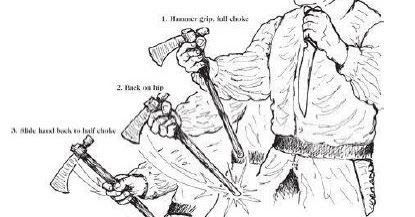
In the first volume, titled simply The Fighting Tomahawk, the author very ably covers all the necessary building blocks that form a good handling skill - in the first section of the book those are grips, stances, guards, deployment; offensive use of the 'hawk (cut, chop, punch, rake); and the defensive use (deflection, interception, blocks). The second section introduces the complementary use of a long knife in conjunction with the tomahawk. The third section presents additional training methods of engagements sets, either solo or with a partner, as well the throwing fundamentals and applications with a war club.
The thing that gives all of this author's book a particularly enticing quality is the use of his own hand drawn illustrations to portray how to perform the material. And to be honest, after almost two decades of having these book, I keep coming back to them for the sheer aesthetic enjoyment and beautiful writing style, as much as the solid information.
With the second volume, McLemore takes a bit different approach. Unlike the first book, which was organized like some kind of a course in the use of a weapon, this one is presented as a sequence of chapters (called Letters) each dealing with an individual aspect of the material in the previous volume, as well as some new stuff, such as the addition of punching and kicking, with special emphasis on training methods. What strikes me as a positive feature is that what we have here is not necessarily advanced methods, but rather deeper understanding of the existing material, hopefully leading to the advanced skill in applications. There are, however, some additions of the original topics, my favorites being the rough and tumble integration of tomahawk with other natural tools as part of chaotic, messy combative encounter as it naturally is; and the use of a long handle tomahawk/hatchet with its specifics that stem from the physical characteristics of the implement.
In an attempt at succinct comparation, I'd say that the first book is a basic course in the subject matter, possibly taught in a class setting, while the second could be viewed as a selection of workshops to be offered along the way for those interested in those details.
Sadly, being that the author is deceased and the original publisher of all his books defunct, the availability of these books may sometimes be a challenge, and they are pricey. But, with the combined heft of 650+ pages, I cannot recommend these enough.
A bit more modern treatise of the tomahawk comes from the hands ofFernan Vargas. Right from the beginning it is obvious, and commendable, that he wasn't trying to compete with the above works in any way, shape or form. Interestingly, although having a strong background in the native American knife combat methods, Vargas is open and clear in stating that his tomahawk material is not rooted in that tradition, but rather an amalgamation of various methods and training experiences he got from a number of instructors and personal development.
His book is titled War Hawk and although visually not so lavish as McLemore's volumes, it is full of solid information, with some important additions, too. Namely, Vargas opens all his book with an overview of the legalities regarding the use of force and the levels of conflict escalation. He then proceeds to cover the essential technical elements of grips, stances, footwork, offense and defense etc, but also offers insights into the combative realms of grappling, solutions for the situations when your attack has been obstructed, and probably most interesting in terms of material not seen in other instructional materials is the chapter on training drills and methods.
The content is clearly demonstrated through the use of text and photos, and while it may not make you enjoy the aesthetics per se, the instructional value is still great.
For the full disclosure - this volume has a LOT of overlap with the first one! I am not sure what is the exact reason for that, but there is an upside to such decision. See, being that the overlap includes the most essential material, you may get this book as a standalone resource and gain the information needed to develop a fairly good skillset. When it comes the techniques and tactics that are new, compared to the previous volume, I would rather label them as secondary than advanced, with a view to prioritizing the training time and focus.
Be as it may, unlike McLemore's books, these are still easily available at a price that doesn't impose the imperative of choosing one or the other. I would recommend getting the first first, to se if you like the material and the presentation, and if you do...it's nice to have the whole set.
VIDEOS
To me, the most natural choice of the first video to feature is, again, the set from Dwight McLemore. The short description would be "the book comes alive", because for the most part the video follows the layout of the book, but that's not all there is to it. Even if it were, it would be still an excellent source to have, especially in conjunction with the printed material. The additions make it superb.
Namely, the author takes the advantage of video format to better portray both certain technical and tactical aspects of the curriculum, as well as some historical ones. That provides a very nice contextual understanding of how he chose the material and why is he teaching it in that way. The content is essentially the amalgamation of the two books, with several interludes (his term) along the way, which discuss the topics that don't follow neatly in the progression of training. Like with the books, those interludes would cover some of the workshop-type approaches, some being historical, others practical. In that regard, there is a rather interesting, albeit brief, observation of the possible transfer of the material to other tools that are widely available in the present day.
All of that is shown through phenomenal camera work and professional editing, and to make the watching experience even more enjoyable, some portions of the video are filmed with participants dressed in the costumes appropriate for the frontier era. That way, McLemore manages to give his stuff that extra quality, like it was the case with drawings in the books.
Our next featured author should be known to my regular readers. Marko Novakovic takes a similar approach to the Fighting Ax instructional as he did with his knife course. There are several things I like about the material. First, it is unapologetically practical, thus completely avoiding to be boggled in the issues of historical accuracy. As a result, it enables the second big plus - the author can bring in the technical and tactical elements from his previous experience in a few martial systems, but wringed through a lot of hands-on testing and experimenting.
When it comes to the actual content, Novakovic touches all the necessary elements in the Intro section of the course (available here) - grips, stances and guards, angles and types of strikes, footwork, hand movement, targets, and ranges of fighting. He then proceeds to work on several solo practice drills in each of three ranges, where he also discusses defensive use; and finally the applications of the material, demonstrated with a training partner.
The presentation is excellent! Although not shot with the budget and production level of the previous feature, the videos are well edited into bite-sized morsels of instruction, where efficient transfer of information is prioritized over aesthetic or entertainment value. Along with the author's avoidance of long rants and tirades, this makes the learning experience more focused and easier flowing than with other titles in this review, and in the day and age of tight time budgets, it is a huge advantage.
Another highly recommended instructional package comes from Cold Steel knife company's head honcho Lynn Thompson, who made a 2-volume DVD set titled - surprise! - The Fighting Tomahawk. The fact that it is the same title as McLemore's could be a bit confusing, but it goes along with Cold Steel's other production in the series (Fighting Machete, Fighting Sarong etc.).
Besides, the overall layout of the material is also rather different.
I mean, it is a VERY comprehensive source (over 4 hours in total), so of course it covers all the bases that the previous works do, but also includes some chapters not seen in the above titles. For example, the video starts with a very good overview of the advantages and disadvantages of tomahawk as a weapon, which is something one should have in mind. Also, being a manufacturer of some of the more popular 'hawk models on the market, Thompson's videos dedicate some time to demonstrate the ways to dismantle and put together your implement (with some quite interesting options, especially for the less than ideal circumstances), as well as how to (re)sharpen it after heavy use. Naturally being a Cold Steel production, there is the mandatory demonstration of the weapon's capacity for inflicting damage.
Like I said, the authors strive to cover a lot of ground with this material, leaving no stones unturned, when it comes to the combative use of the tomahawks and light hatchets. It means that the historical background and accuracy are out of the picture as a concern, and the heavy stress is on all kinds of way that the tool can be put to use in an altercation. Such approach yielded a wider array of options shown than by other authors in terms of grips and holds, as well as the distance management options via footwork. A number of drills demonstrated will probably look more modern, borrowing from the sport science methods, and that suits the general atmosphere of the videos pretty well.
The only downside to this set, compared to others is that the wealth of information might leave you scratching your head, wondering where exactly to start and how to follow the material in order to get a proper progression in training.
With that in mind, it is very useful to see how to make your own training tool required to take the full advantage of the training methods covered by the videos, which is another welcome aspect of this instructional product.
Finally, the last feature in this category is the one authored by another of our acquaintances, Mark Hatmaker. His is a very well done volume titled Battle Axe Secrets, and unlike his RAW series, it is produced professionally by TRS (hehe, remember those Black Belt "report" type ads?), but available directly from the author.
As you may expect, since this work deals with a somewhat heavier and bigger tools that your typical tomahawk, the instructional is a bit different, with much more attention given to two-handed manner of wielding the weapon, but don't let that discourage you. Namely, the training methods are readily applicable to lighter tools, too, but it is another dimension that is at play here. One of the main reasons I like Hatmaker's stuff is his focus on the precise mechanics of delivery, and when you are dealing with an instrument that could easily lead to self-inflicted injuries (whether from misuse or overuse) it should be highly prioritized in your work. Plus, you get a really good workout!
Another good reason to check this package is that upon ordering from Hatmaker's website, he normally sends you a document that delineates a training syllabus for you, thus providing a solid foundation for any future work.
FINAL REMARKS
Now, I know this seems like a lot of material, and there is the question of where to start. Well, if you are into the historical study, go with McLemore's works. Need a quick start with functional skillset? Then opt for Novakovic and/or Vargas. Should you want a single, standalone product that covers all the bases - Thompson is your man. In case of being an analytical person with an eye toward a sustainable practice that has a lot of carryover to other training field, you won't go wrong with Hatmaker. Be as it may, tomahawks and hatchets have a certain nature that one ought to keep in mind when engaging in this kind of work.
There, you have it. Hopefully this sheds enough light on the domain to help you pick the right source for your needs. Oh, and speaking of needs, if you may be asking yourself, what is the relevance of this kind of information and training, besides possibly professional operative deployment work, I will offer more insights in one of the following posts.
Funny think struck me the other day. Not really an epiphany, but more like finally finding the missing part of the puzzle sort of reasoning. "About what?" you may ask...
Well, I have never been a kind of guy who desperately needs ostentatious recognition and/or ceremonies within a hierarchical organization in order to feel valued or as a confirmation of whether my training and effort had been worthwhile. Yet, it does not mean I feel disdain or other negative attitude toward various organizations (let's stay with martial arts here) per se. Some of them are functional, serving the purpose of making things easier for the members, some are unfortunately their very own raison d'etre, but it is not really any different than in other fields of life. Anyway, I did notice that some of those associations I liked better than others, and sometimes wondered why.
Sometimes I would think it depended on their administrative setting, other times I thought it had to do with the training methodology, maybe declared philosophy. mission etc. But no, there is another decisive factory.
We now get back to the beginning of this post. I received the latest book, War Hawk, written by Fernan Vargas, and got into a brief correspondence/conversation with the author. I was familiar with some of his earlier works (hence my initiative for obtaining this one), and our exchanges confirmed the impression I had of Mr Vargas. His demeanor showed a humble and honest man, always eager to learn more and new things, shying away from the pretentious status of grandmastery and other related aspects. On the other hand, his actual high level of expertise on the matter he teaches and does is evident in the process of sincerely sharing the knowledge he had accumulated over the decades of practice.
And so, as the birds of the feather flock together, Vargas seems to be gathering a colorful band of people of the similar ilk in his Raven Tactical International in a loose structural organization, but with the tight bond of common values. Finally, this is where I had my light-bulb moment - it is the fraternal feeling of non-enforced tribal belonging that some organizations have that I tend to appreciate. In such cases, even if I don't share the same views and interests of the said associations, there is still the tendency to enjoy the company of their members, relieved of any need to prove something to the rest of the world, content in belonging to where they feel at home.
Another nice commonality in such organizations is that their members tend to be ready and willing to learn from each others and help each other grow, regardless of their previous experience, background or "level" in the group. It is the supportive and not fiercely competitive atmosphere that enables the development to mean true growth and maturing, and not just plain expansion for the sake of numbers.
The aforementioned published works of Fernan Vargas and his associates are a nice example of this attitude. They all start with some very important notions and clear ego-check points that are too often either taken for granted or ignored altogether. Oh, and when it comes to the value of the contents, one would be severely challenged to find a better ratio of the proverbial bang for the buck.
Naturally, the Raven bunch is not the only crew of that sort, or worth mentioning in this light (Systema Homo Ludens of Alex Kostic, Astig Lameco of Roger Agbulos, Libre Fighting of Scott Babb, Combat Systema of Kevin Secours, to mention just a few), but being that they happened to be responsible for my "moment of insight" I devoted the space to them.
Liking other types of organizations and their inner workings is absolutely fine, as long as you find what you are looking for in them. It is just my personal preference to gravitate toward certain types of communities, and I am he author of this blog, so...
NOTICE: I am in no way and by no means affiliated with the RTI or Mr Vargas. This entire piece of writing was completely unsolicited by any of the mentioned parties. It represents my honest opinion, based on my personal experience with those subjects, so take it for what it is.