...or, in a word - Bowie! It is probably safe to say that my interest in combative use of the bowie knife comes from the same dimension as that regarding tomahawk. This time however, I will split the review of the materials into three categories: introductory; comprehensive course; and additional resources. In presenting them, the order in which the materials are presented is based on the alphabetical order of the authors' last name. So, without further ado...
James Keating's double video package titled Legacy of Steel is essentially the edited recording of one of his legendary Riddle of Steel camps that he used to run annually for a number of years. It was professionally recorded and edited by the good folks of the Paladin Press, so we all can benefit from this work. And benefits abound! The first volume of the pack is titled Left Hand Path and deals with the close quarters use of smaller knives, the method being strongly influenced by FMA approach, and as good as it is (more like awesome), we shall focus today on the second volume - the Right Hand Path.
What we have here is roughly a 50-minute introduction to all the fundamental aspects regarding the usage of bowie-type, i.e. big knives. Keating starts with a spoken introduction to the specifics of this kind of knife, thus providing the context for the better understanding of the instruction that follows. He is than joined by another Comtech instructor, Rob Langford, who gives an excellent explanation of the timing that makes the bowie knife such a feared and respected implement. In practice, he analyzes and demonstrates teh mechanics of non-telegraphing striking, exemplified on this occasion by the straight thrust. Keating takes over the instruction to work on the topics of guard, with focus on the blind-spot targeting, and stance that serves as a mobile platform for the whole thing. Next, he shows the tactical maneuvers of in quartata and passata soto that allow you to place your thrusts as counters to the opponents initiative. In the last section, Langford steps in again to teach the functioning of the often mentioned but rarely understood specialty of of the bowie - back cut!
All in all, this is a great video, which should give an excellent overview of what the bowie knife is about, and if you practice the material diligently, it should give you a fairly sufficient command of the tool in practice, in case you do not want to investigate further.
The next piece is a book from Marc Lawrence, with a rather interesting take on the subject. Specifically, as indicated by the title American Bowie Knife Methods From the 1880s, the author takes a HEMA-type approach. Even the historical overview of the origins and popularity of the weapon itself is shown through a newspaper article from 1888, with all of the possible inaccuracies and bias, so the interpretation is left to the reader. When it comes to the fighting methods, he uses two newspaper articles from 1890 and 1888 (in that order for some reason), and then uses the information therein to formulate a couple dozen drills and exercises in order to put the material into practice. According to him, the goal here is to help the readers/practitioners to the level of skill demonstrated by the exponents, as described in the original articles.
Now, this approach is interesting for a couple of reasons. First, most instructors teaching the bowie knife today are explicit in saying that there is no a sure way to establish the period-authenticity of the techniques and methods used, i.e. that we can't know with certainty how Jim Bowie himself or other exponents in the first half of the 19th century, presumably the heyday of this type of knife, fought or taught their craft. Lawrence attempts to get us as close as possible, using the information that is as close as possible to the historical period and geographical region concerned. Second, while most practitioners would use this kind of resource to maybe pick up a couple of techniques or tactics at best, he strives to look beyond mere individual nuggets and see a bigger picture, thus developing an actual training plan that would get us to a higher level of understanding and, consequently, skill.
It has to be noted that the two articles used as mining source are quite similar, possibly a retelling of the same story.What are the implication of this fact to the historical authenticity and technical accuracy of the content...I leave that to the reader to ponder.
Among these three resources, James Loriega's book Behind the Bowie Blade is the only one that offers some comprehensiveness in its historical introduction, regarding the origin of the tool, particularly with regards to the influences of other cultures and earlier blade designs that were present in the southern part of today's USA in 1830's, where the roots of the phenomenon are.
Unlike the previous author, Loriega adheres to the subtitle - A Personal Method of Edged Defense - when treating the hands-on portion of the book. It means we get to see his own interpretation of how a big knife ought to be used for the combative purpose. While doing that, he covers all the bases required for a well rounded grasp of the situation: cuts, thrusts and related fundamentals; attack and defense; footwork and targeting; recommendations for safe training, including several suitable models of training knives for this kind of work.
Now, the author offers a rather succinct sort of instruction, primarily relying on written descriptions and very few illustrations. In itself that wouldn't bother me much, if there wasn't for the fact that out of 100 pages of this book as many as 15 (fifteen!) are used for a selection of posters and pictures from the a number of movies and TV shows that dealt with the lore of Jim Bowie. Aside from a possible bit of nostalgia trip for some of the readers, it seems to me that this space would have been much better used for a somewhat more detailed coverage of the instructional portion of the book. That said, it is an expensive book, and probably goes in tandem with Keating's video better that the previous one, due to a more conceptual method of approaching the material.
If these resources succeed in awakening more interest for the subject matter, keep en eye on the following posts about it.
When I first got interested in knife related combative issues, back in mid-90's, there were few printed resources available, and not all of them good. Having had a few years of traditional/typical martial art training under my belt, I was, naturally looking for methods that looked legit by having a more or less set curriculum and training progression to follow...and actually found a couple of training manuals that fit in with such criteria. Then, I stumbled upon a small book that didn't, but instead it raised some uncomfortable issues and made me ponder difficult questions, which happened to shed a new light on the whole subject...
Obviously, it offered a look from the perspective we don't usually think of, thus painting a more realistic picture of the problem that one may face, involving blades. To be honest, I don't know whether the book is still available, but ultimately - it doesn't matter.
Enter the main topic of today's post - Medusa edged weapons system! The background story doesn't sound too uncommon: a couple of practitioners weren't exactly satisfied with regular, readily accessible methods of dealing with knife threats and associated problems, so they started looking for more practical solutions. The fact that they were a father and son combo of Mike and Seth Raymond makes it a bit more interesting, but ultimately they turned to the US penal/correctional system, reckoning that most of today's reality blade users reside there. If you are interested into their research method, check this interview out:
Another key figure in the development of Medusa is its leading instructor Jason Schultz, a long time practitioner of martial arts and combatives, with an eye toward practicality and focus on the combative methods with roots in WWII. The thing is, Mr. Schultz really boiled the teaching down into a set of tools and principles that accelerate the training process, and then he wrote a manual about it.
Now, it is a rather short read, but covers all the info you need in order to develop a functional skill in handling a knife (or shank) in a defensive situation. Besides, there is not much talking here about history, lineage, (pseudo)philosophy, or even knife related stuff like selection, carry or deployment (all of which are often predicated on individual preferences and environment), nor on the legalities of using blades in self-defense situations (variable from one locale to another).
What the author does cover, on the other hand, are the topics of basic tactical protocol, grips and thrusts, stance, movement, target zones, some specific tactics (throttling, stick shifting), and a few sample sequences/combos to work on. Interestingly enough, the section on knife vs. knife type of encounter is very short. That is because Mr. Schultz stresses the importance of mindset and simplicity of technical arsenal as the foundation of the Medusa approach to fighting.
The way I see it, the real significance of this manual, and Medusa system as a whole, is not in coming up with another "ultimate supreme" new combative recipe, but rather in helping you understand the problem, i.e. the kind of adversary you might one day have to face...and hopefully prevail. In that regard, this is probably the best source you can find at the moment, and I cannot recommend it enough. After studying the material in this book, and putting it into practice, that task should be easier to complete. After all, what use are the latest, cutting edge technology sights if you are aiming in the wrong direction?
If you are intrigued, the manual is available as a PDF download, so you can "get your hands dirty" ASAP. If you are more of a video type of person and would like to learn more, make sure to find and follow the author on Instagram, where his profile is benkei_sohei.
Here is one of those topics in martial training that tends to be divisive, although it really doesn't need to be. See, in the traditional arts there is often a lot of emphasis on practicing any and all techniques on both sides equally, with the declared ideal of becoming ambidextrous in application. Let me state it right here - I don't think you can ever become truly ambidextrous from training, no matter how many sinawali patterns you happen to learn...however, becoming bilaterally functional is another thing.
But, let's take a step back. For the opponents of the idea of bilateral training, since most of us are not professionals in the field and don't have all the time in the world to only focus on training, the limited time we do have on disposal ought to be dedicated to developing the best possibly performance ability on the preferred side. Interestingly, the professionals, who can and do dedicate their lives to training, for the most part also firmly belong to this camp. After all, how many boxers do you know who can switch stances fluidly and box equally well on both sides? It brings to memory an old interview of Bill "Superfoot" Wallace, the legendary full contact champion, who only kicked with his left foot. Namely, asked about that he said that faced with a choice of having two good legs (if not mediocre) or one that is unstoppably phenomenal, he chose the later. And from the standpoint of a competitor whose belt is on the line, it makes sense. After all, symmetry is not even natural, right?
Hmmm...
But, what about those of us who aren't high level competitors, so no big money or titles on the line? Plus, the self-defense oriented community resorts to the argument of defending when your strong/dominant side is injured. And before some of you laugh an point that if the opponent is good enough to eliminate our string side option, the other will be a joke, let me point out that not all injuries are incurred in an encounter as such. For example, I am currently boasting a bad case of tendinitis in my right wrist, unrelated to training, and I'd rather train with my left than not at all.
That said, it is not even the main benefit I see in the bilateral approach. The biggest advantage there is to it, lies in the fact that such endeavor shows strong benefits to the maintenance and improvement of the overall neural and cognitive systems. Creating new neural pathways, firing synapses etc, it all has long term good effects on human health and functioning.
Since the work on the non-dominant side essentially stimulates the "opposite" side of the brain, typically related to creativity and intuitive thinking, this might even enhance one's ability to find new solutions to the problems faced. The maintenance of the neural and cognitive networks as also VERY important in the advanced age, to prevent dementia and other degenerative issues.
However, we don't even have to go into brain science to see other, possibly more evident upsides. Depending on the chosen training discipline, training exclusively on one side may lead to an unbalanced muscular development (particularly when training with heavy implements/weapons), which in turn results in problems with posture and movement patterns, further loading the compensatory joints and movements, and the injuries that will stem from that.
By the way, if you also include regular conditioning work in your training process, such as weight lifting, roadwork, intervals and so on, would you approach that work with emphasis on the dominant side only? Yeah, I though so...
There is a kind of a third way, too! Years ago, I talked to a pencak silat instructor about this subject, nudged by his "don't care" attitude about whether the jurus of his system (forms) should be practiced in the mirror image as well, since they are not symmetrical on their own. His response was that that a practitioner could develop two different sets of responses for the attack coming on similar lines but from two different sides. I found it awkward at the time, but later it started making sense. Again, going back to weapon-based systems, you just have to work this way! Well, unless you switch the tool between the two hands or grips to deal with the stimuli from left or right.
In conclusion, I'm afraid there is till no definitive answer to the debate, but hopefully you will find some information here that will help you organize your training better, according to your own needs and priorities.
As you should be aware by now, I have a healthy dose of respect for anyone involved with serious martial training, whether traditional or modern aspects of it, i.e. looking for cultural preservation, sporting applications or functional combative skills. One rather interesting subset of the first category is the HEMA (historical European martial arts) community, but with an interesting specific feature. Namely, while the majority of Asian declaratively traditional systems are based on some kind of "living, unbroken lineage from the founder, the HEMA approach is actually mostly founded on the efforts toward reconstruction- trying to revive what is for the most part lost legacy from the historical manuals about the methods of use of the weapons and armory characteristic for the periods of medieval time and the renaissance.
Oddly enough, the period(s) after that, which means once the firearms got into regular and large-scale use, are not really in the focus of this group. As a result, that leaves an implement that I find very interesting and still relevant on the margins of interest among the enthusiasts - tomahawk. Fortunately, over the past couple of decades it got some serious treatment from a handful of some superbly dedicated instructors, and their work gives us some excellent material to work from. Now, as is the case with my path in the overall fighting domain, the emphasis is on the functional application of the tool, with not much attention to the historical accuracy of the methods of use. That said, I will split this post into two mediums...
BOOKS
The absolute giant in this category, and deservedly so, is the late Col. Dwight McLemore, and if you have any interest in the tomahawk. His two books are seminal works, and they try to address the historical context of the weapon too, but when it comes to the utilization, it is not the main criterion.
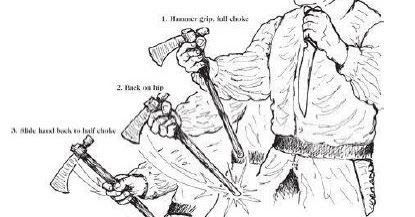
In the first volume, titled simply The Fighting Tomahawk, the author very ably covers all the necessary building blocks that form a good handling skill - in the first section of the book those are grips, stances, guards, deployment; offensive use of the 'hawk (cut, chop, punch, rake); and the defensive use (deflection, interception, blocks). The second section introduces the complementary use of a long knife in conjunction with the tomahawk. The third section presents additional training methods of engagements sets, either solo or with a partner, as well the throwing fundamentals and applications with a war club.
The thing that gives all of this author's book a particularly enticing quality is the use of his own hand drawn illustrations to portray how to perform the material. And to be honest, after almost two decades of having these book, I keep coming back to them for the sheer aesthetic enjoyment and beautiful writing style, as much as the solid information.
With the second volume, McLemore takes a bit different approach. Unlike the first book, which was organized like some kind of a course in the use of a weapon, this one is presented as a sequence of chapters (called Letters) each dealing with an individual aspect of the material in the previous volume, as well as some new stuff, such as the addition of punching and kicking, with special emphasis on training methods. What strikes me as a positive feature is that what we have here is not necessarily advanced methods, but rather deeper understanding of the existing material, hopefully leading to the advanced skill in applications. There are, however, some additions of the original topics, my favorites being the rough and tumble integration of tomahawk with other natural tools as part of chaotic, messy combative encounter as it naturally is; and the use of a long handle tomahawk/hatchet with its specifics that stem from the physical characteristics of the implement.
In an attempt at succinct comparation, I'd say that the first book is a basic course in the subject matter, possibly taught in a class setting, while the second could be viewed as a selection of workshops to be offered along the way for those interested in those details.
Sadly, being that the author is deceased and the original publisher of all his books defunct, the availability of these books may sometimes be a challenge, and they are pricey. But, with the combined heft of 650+ pages, I cannot recommend these enough.
A bit more modern treatise of the tomahawk comes from the hands ofFernan Vargas. Right from the beginning it is obvious, and commendable, that he wasn't trying to compete with the above works in any way, shape or form. Interestingly, although having a strong background in the native American knife combat methods, Vargas is open and clear in stating that his tomahawk material is not rooted in that tradition, but rather an amalgamation of various methods and training experiences he got from a number of instructors and personal development.
His book is titled War Hawk and although visually not so lavish as McLemore's volumes, it is full of solid information, with some important additions, too. Namely, Vargas opens all his book with an overview of the legalities regarding the use of force and the levels of conflict escalation. He then proceeds to cover the essential technical elements of grips, stances, footwork, offense and defense etc, but also offers insights into the combative realms of grappling, solutions for the situations when your attack has been obstructed, and probably most interesting in terms of material not seen in other instructional materials is the chapter on training drills and methods.
The content is clearly demonstrated through the use of text and photos, and while it may not make you enjoy the aesthetics per se, the instructional value is still great.
For the full disclosure - this volume has a LOT of overlap with the first one! I am not sure what is the exact reason for that, but there is an upside to such decision. See, being that the overlap includes the most essential material, you may get this book as a standalone resource and gain the information needed to develop a fairly good skillset. When it comes the techniques and tactics that are new, compared to the previous volume, I would rather label them as secondary than advanced, with a view to prioritizing the training time and focus.
Be as it may, unlike McLemore's books, these are still easily available at a price that doesn't impose the imperative of choosing one or the other. I would recommend getting the first first, to se if you like the material and the presentation, and if you do...it's nice to have the whole set.
VIDEOS
To me, the most natural choice of the first video to feature is, again, the set from Dwight McLemore. The short description would be "the book comes alive", because for the most part the video follows the layout of the book, but that's not all there is to it. Even if it were, it would be still an excellent source to have, especially in conjunction with the printed material. The additions make it superb.
Namely, the author takes the advantage of video format to better portray both certain technical and tactical aspects of the curriculum, as well as some historical ones. That provides a very nice contextual understanding of how he chose the material and why is he teaching it in that way. The content is essentially the amalgamation of the two books, with several interludes (his term) along the way, which discuss the topics that don't follow neatly in the progression of training. Like with the books, those interludes would cover some of the workshop-type approaches, some being historical, others practical. In that regard, there is a rather interesting, albeit brief, observation of the possible transfer of the material to other tools that are widely available in the present day.
All of that is shown through phenomenal camera work and professional editing, and to make the watching experience even more enjoyable, some portions of the video are filmed with participants dressed in the costumes appropriate for the frontier era. That way, McLemore manages to give his stuff that extra quality, like it was the case with drawings in the books.
Our next featured author should be known to my regular readers. Marko Novakovic takes a similar approach to the Fighting Ax instructional as he did with his knife course. There are several things I like about the material. First, it is unapologetically practical, thus completely avoiding to be boggled in the issues of historical accuracy. As a result, it enables the second big plus - the author can bring in the technical and tactical elements from his previous experience in a few martial systems, but wringed through a lot of hands-on testing and experimenting.
When it comes to the actual content, Novakovic touches all the necessary elements in the Intro section of the course (available here) - grips, stances and guards, angles and types of strikes, footwork, hand movement, targets, and ranges of fighting. He then proceeds to work on several solo practice drills in each of three ranges, where he also discusses defensive use; and finally the applications of the material, demonstrated with a training partner.
The presentation is excellent! Although not shot with the budget and production level of the previous feature, the videos are well edited into bite-sized morsels of instruction, where efficient transfer of information is prioritized over aesthetic or entertainment value. Along with the author's avoidance of long rants and tirades, this makes the learning experience more focused and easier flowing than with other titles in this review, and in the day and age of tight time budgets, it is a huge advantage.
Another highly recommended instructional package comes from Cold Steel knife company's head honcho Lynn Thompson, who made a 2-volume DVD set titled - surprise! - The Fighting Tomahawk. The fact that it is the same title as McLemore's could be a bit confusing, but it goes along with Cold Steel's other production in the series (Fighting Machete, Fighting Sarong etc.).
Besides, the overall layout of the material is also rather different.
I mean, it is a VERY comprehensive source (over 4 hours in total), so of course it covers all the bases that the previous works do, but also includes some chapters not seen in the above titles. For example, the video starts with a very good overview of the advantages and disadvantages of tomahawk as a weapon, which is something one should have in mind. Also, being a manufacturer of some of the more popular 'hawk models on the market, Thompson's videos dedicate some time to demonstrate the ways to dismantle and put together your implement (with some quite interesting options, especially for the less than ideal circumstances), as well as how to (re)sharpen it after heavy use. Naturally being a Cold Steel production, there is the mandatory demonstration of the weapon's capacity for inflicting damage.
Like I said, the authors strive to cover a lot of ground with this material, leaving no stones unturned, when it comes to the combative use of the tomahawks and light hatchets. It means that the historical background and accuracy are out of the picture as a concern, and the heavy stress is on all kinds of way that the tool can be put to use in an altercation. Such approach yielded a wider array of options shown than by other authors in terms of grips and holds, as well as the distance management options via footwork. A number of drills demonstrated will probably look more modern, borrowing from the sport science methods, and that suits the general atmosphere of the videos pretty well.
The only downside to this set, compared to others is that the wealth of information might leave you scratching your head, wondering where exactly to start and how to follow the material in order to get a proper progression in training.
With that in mind, it is very useful to see how to make your own training tool required to take the full advantage of the training methods covered by the videos, which is another welcome aspect of this instructional product.
Finally, the last feature in this category is the one authored by another of our acquaintances, Mark Hatmaker. His is a very well done volume titled Battle Axe Secrets, and unlike his RAW series, it is produced professionally by TRS (hehe, remember those Black Belt "report" type ads?), but available directly from the author.
As you may expect, since this work deals with a somewhat heavier and bigger tools that your typical tomahawk, the instructional is a bit different, with much more attention given to two-handed manner of wielding the weapon, but don't let that discourage you. Namely, the training methods are readily applicable to lighter tools, too, but it is another dimension that is at play here. One of the main reasons I like Hatmaker's stuff is his focus on the precise mechanics of delivery, and when you are dealing with an instrument that could easily lead to self-inflicted injuries (whether from misuse or overuse) it should be highly prioritized in your work. Plus, you get a really good workout!
Another good reason to check this package is that upon ordering from Hatmaker's website, he normally sends you a document that delineates a training syllabus for you, thus providing a solid foundation for any future work.
FINAL REMARKS
Now, I know this seems like a lot of material, and there is the question of where to start. Well, if you are into the historical study, go with McLemore's works. Need a quick start with functional skillset? Then opt for Novakovic and/or Vargas. Should you want a single, standalone product that covers all the bases - Thompson is your man. In case of being an analytical person with an eye toward a sustainable practice that has a lot of carryover to other training field, you won't go wrong with Hatmaker. Be as it may, tomahawks and hatchets have a certain nature that one ought to keep in mind when engaging in this kind of work.
There, you have it. Hopefully this sheds enough light on the domain to help you pick the right source for your needs. Oh, and speaking of needs, if you may be asking yourself, what is the relevance of this kind of information and training, besides possibly professional operative deployment work, I will offer more insights in one of the following posts.
When I started writing about various challenges one one's training path (also here, here, and here), it was mostly about the elements that a good training process required, one way or another, in order to produce good results. This time, however, I'd like to address one of the desired outcomes of such process, as there are some debates on whether it can be achieved.
The way I see it, for many people their skepticism with regards to whether training could yield toughness in a practitioner (if they hadn't already possessed this quality) is rooted in what seems to me to be the wrong question - can it be taught? From that standpoint, I would probably be inclined to agree... Because it is not meant to be taught! Toughness is the kind of attribute that can definitely be cultivated.
But, to get there, we first need to have some kind of working definition of just what is it that we are seeking to develop in a trainee. In the field of engineering toughness, as a mechanical quality of a certain material, is not the same thing as hardness or resilience etc. But then, they do not have to be concerned with the mental component, right? And in the realm of physical training, toughness is actually predominantly mentioned as a mental attribute.
In the fight game, this quality is also described as grit, clout, guts etc. So, to be on the same page, let's describe toughness as the ability to stay on the course and get to the goal, in face of challenges and despite the obstacles. Obviously, in the combative world, whether it be a sport arena, field of battle, or mean city streets, challenges and obstacles may vary, thus implying several building blocks of toughness. For example, tolerance to pain, ability to take a hit (physical traits), as well as executing proper tactical maneuvers effectively and efficiently (technical traits), but also facing the unfavorable odds and refusing to surrender (mental traits).
Once we take stock of all those necessary components, it becomes clearer why toughness cannot be taught, especially not in a single act; cultivation, on the other hand is process, and as such it takes time and effort...from both the trainees and their coaches. All right, so how to tackle this thing? Well, actually, we might take a look at the mechanical engineering for some hints!
In the above formula (gasp!), we see that the toughness is the result of a few other parts of the equation. For our purpose, let's look at Y (geometrical factor) as the sum of technical prerequisites of a given discipline (stance, balance, power generation, offensive/defensive moves); the next element - σ (Greek letter sigma) - i.e. the applied engineering stress stands for the selection of adequate training methods (pressure drills, sparring, scenarios, doing reps, equipment training etc.); while the final a points to adequate challenge/demand setting - just beyond the current reach of the trainee, but that does not look beyond achievable at all (if it seems impossible or unrealistic, it will fail to motivate action).
Pay attention to the sequence of things here! It is frequently said that once the athlete has all the technical demands and physicalconditioning in order, the work is 90% mental and 10% physical (search for "fitness" on this blog). This is why raw laypeople, taken from the street are unable to defeat high-level athletes despite how bad they might want it, but when two elite competitors face each other the mental preparation usually tips the scale.
On more of a meta-level, in his book Do Hard Things [...] Science of Real Toughness author Steve Magness points to four pillars of successful work on the development of this quality: 1) ditch the façade, face the reality; 2) listen to your body; 3) respond, instead of react; 4) transcend discomfort. This is a pretty good sublimation of some of the topics discussed in the links in the above text, and although the book itself is not aimed at martial artists as such, it is a good read for those interested in this particular issue.
In the end, I'd like to conclude with a couple of pointers - be patient, work with long-term in mind, trust the process!
Well, this was supposed to be my last article for 2022, but it wasn't meant to be. So, instead of ending the last year with a bang - here's to a happy and prosperous 2023!
Back in the 1990's, prior to Internet and Youtube, the only way to find out about new and interesting martial stuff out there was reading about it in magazines such as Black Belt. Otherwise, you would have to order a tape (yeah, VHS) from an author you had seen in an ad in those magazines. And those weren't cheap! At one point, the Black Belt actually came up with the idea of putting out a video magazine, and it looked exciting in their ads, but...at the time I just couldn't find the way of ordering to where I lived, and never got too see them to this day.
Fast forward a decade or so, and a gentleman named Pete Kautz, the founder of the Alliance Martial Arts decided to do a similar thing, but in a DVD format, featuring himself and James Keating as regular contributors in each issue, along with a guest or two being featured as well. Each issue focused on a single topic, and although titled Modern Knives, it wasn't dedicated solely to the edged weapons. Since I had already been a fan of their work, and been interested in what they had to show, as well as discovering new exponents, I ordered the first eight issues (i.e. all they had at that point) some 15 years ago. And guess what? I keep re-wathcing those somewhat frequently to this day. So, let's lee what they're all about!
First, a few words about the format and production. Typically, the DVD's are organized into chapters, where Keating usually takes the lead, followed by the featured guest, and then Kautz closing the instructional part. A first few issues also had a review of some instructional video's available, too - and, as you may imagine, I loved those. As the matter of fact, I ended up buying Blaise Loong's Sabungin Silat series after seeing the review in Modern Knives! Naturally, the reviews strived to cover the material that fits the topic of that issue. The video production is quite good, even if not always done with fully professional equipment, but both image and sound are clear, so the content is clear and easy to follow. Again, the videos have navigable menus with chapters, thus causing no inconvenience for the viewer.
Oh, the only aspect that gives out the "homemade" nature of the entire publishing operation is how the DVD jackets are done. Still, it didn't bother me the least - the cover image is indicative of the theme, and the back cover gives the content outline, which even many professionally produced and published videos before and since then failed to do.
front...
...and back
The issue #1 is about the the Spanish Fighting Arts. Keating opens up with with some instruction about the often misunderstood and/or neglected topic of how to use the so-called Spanish notch on some of the bigger fighting knives out there (including his own design - Crossada). He also touches upon the utilization of the knife's guard for the trapping purposes in the clinch phase of a knife fight/duel. Obviously, this material is mostly applicable with big blades, but those are rather interesting insights.
The guest author in the 1st issue is James Loriega, best known for his promotion of the knife fighting methods using traditional navaja folding knives of Spain. To me, this was the most interesting feature, because it is (still) one of the very few possibilities of actually seeing Loriega's material in action. Namely, despite having a few books on the subject published, they are not very clear with regards of how the techniques are executed (maybe even deliberately?), so if you have any interest in this domain - this DVD should be on your list of priorities.
Kautz goes into what is possibly the most evidently Spanish influence in FMA, i.e. the espada y daga approach to using a long and short blade simultaneously in combat. He presents the material along the lines of the so-called cinco teros (5 strikes) method of instruction, and offers what is probably one of the best available introductory lessons on this manner of armed fighting.
The video review in this issue is about the La Verdadera Destreza school of fencing, as presented by maestro Ramon Martinez.
The issue #2 deals with another geographical region - South East Asian Fighting Arts. Keating shows a very interesting method of using the kerambit knife, based on his Hellbows material. What I really liked about this is the conceptual nature of instruction, that integrates the defensive and offensive applications of the moves, doable without the weapon, too.
The legendary Kelly Worden is a featured guest instructor in what is actually a segment of his seminar on the FMA knife. A portion of his material is shown with Worden's patented Travel Wrench tool, and I liked it for the crossover applicability with other small palmstick-type tools and improvised weapons of similar characteristics.
Kautz teaches the triangle thrusting drill of the FMA and its variations, adaptations and applications. Again, in accord with his conceptual overall approach, he goes beyond the most obvious purpose of the drill and shows us how to see deeper into the work. These insights are meant to teach you how to get more mileage from any other type of drill and training method you may be using.
The review is focused on the above mentioned Sabungin Silat DVD series.
The issue #3 is closes to the title of whole series - Modern Knife Concepts. In it, Keating goes into the specifics of use with his signature Chinook folding knife made by Spyderco. It is always interesting to see and hear what a knife designer had in mind when coming up with his or her personal model, and this is no exception. Probably my favorite part was the use of a small, folding knife for back cut technique typically associated with much bigger weapons.
As the guest instructor, ninjutsu instructor Dale Seago does a rather interesting feature about the defense from an unexpected knife attack. I particularly appreciated how he connected cultural and philosophical layers of his art with the tactical and technical applications. That said, the very idea of training/drilling something unexpected is somewhat paradoxical, but there is still quite a bit of value to be gained from this chapter.
Finally, Kautz offers an excellent segment on the extensions and variations of the Comtech Drawpoint method of the knife used in the reverse grip manner. Now, this portion of the material is very useful when taken on its own, but even more so if you have also seen and worked on Keating's original material. It is also a brilliant example of how practitioners can take what they had learned and then put their own flavor to it, and how do do it right!
This is NOT a clip from the described DVD, but gives a fairly good taste of how Kautz does his material there.
The issue #4 is about the Western Martial Arts. This time, instead of being geographically specific, the focus is more on the historical research of the combat methods of Europe and America. Interestingly enough, Keating features a niche kind of material here - single action revolver twirling. Now, if you are not into firearms this may not be of interest at all, and if you are, you may wonder about the practical value of the stuff shown. The way I see it, attempting this material is aimed to achieve developmental effects, i.e. working on your attributes, and particularly the frequently missed benefits to honing one's neural connections and coordination.
Featured guest Bob Charon gives a presentation of the dagger fighting methods from the late medieval manual of Fiore Dei Liberi, i.e. Flos Duellatorum from 1410. It gives us insight into some of the time tested and confirmed principles of combat, regardless of the place they were used in. Also, should you be among the folks who believe the whole HEMA things is just a bunch of guys and gals involved into some sort of glorified costume-wearing reenactment play, it may open your eyes to practical benefits of studying this kind of material.
In the footsteps of the previous chapter, Kautz shows more dagger from another medieval master - this time a German one, Andre Lignitzer. Again, this is not so much about historical accuracy, but more looking toward how it can still be researched to find the worthwhile aspects for our day and age.
The issue #5 stays with the previous theme to a degree, and gives the viewer an incredible amount of information, since it deals with the American Bowie Knife. Now, Keating has long been recognized as one of the leading authorities in this domain, and once more he goes one step further than most other instructors. Namely, the bowie is most often perceived as a dueling implement nowadays, but back in the day it was probably seen more as a great backup weapon/tool, which is where Keating's treatment of the knife in tandem with a revolver is a unique value. Weapon deployment, retention and transition are the name of the game here, and the implications to footwork, distance and angling are as important as any other element. So, don't skip this part!
The late distinguished author Dwight McLemore focuses on one of the bowie knife signature moves - the snap cut - but specifically how do defend against this deceptive and destructive tactic. Like the previous chapter, this is they kind of instruction that is hard to find elsewhere, thus making the DVD that more valuable.
As if the above was not enough, Kautz demonstrates the application of historical sabre fencing techniques with the bowie knife, hence elucidating on some of the highly probably sources of this knife material in the first place. On top of it, we see done the techniques used against the bayonet attacks, which is, again, how the bowie was probably often used in its original environment.
But, there is even more! To give you even more insights into the phenomenon of this legendary blade, we are given a glimpse into the forging of a true fighting bowie under the hands of the legendary master blade maker Bill Bagwell, as well as the suggestions for the every day carry options from the sheath maker Mike Sastre. All in all, one heck of a great and informative DVD!
The issue #6 takes a step away from the blades and is concerned instead with Filipino Stick Fighting methods, and here we have a 2 DVD set. Keating leads the way with a series of options of using the stick as a tool for LEOs, i.e. teaching the locks and releases to control the opponent, where simply using the baton as an impact weapon may not be appropriate.
Dr. Remy Presas, the son of the legendary master Remy A. Presas of the Modern Arnis fame, is shown in a fragment of a seminar, teaching the counter for counter methods and tactics of his art. I liked that the editor (Pete Kautz) chose the material that really fits well with Keating's, and the viewer should probably try investigating how they could be combined. If this is your field of interest, you should be able to spend a long time in discovering modes and options of use with these.
Another guest instructor is Ken Smith, and his chapter is maybe my favorite here. Namely, he goes into Sibat, the long staff material, and for some reason I have always felt some primordial pleasure when handling this tool. Smith demonstrates a two-ended staff approach in his segment, showing how some well known FMA drills and exercises, normally done with a regular stick, can be adapted to and used with sibat.
Finally, Kautz delivers another phenomenal instructional package with his explanation of how to functionalize siniwali (double stick) material. Like before, he teaches us how to see "behind the curtain" of simple movements and movement patters, and into the driving engine behind them. And this not another set of interpretations of the meaning/applications of the already familiar mover, like with so many other FMA instructors. No, Kautz deconstructs the mechanics of strokes, their lines, trajectories and sectors, and then shows you how to come up with your own patterns and applications. In other words, he does not give you a vocabulary of words, but the actual grammar that makes one fluent in "speaking" siniwali. Highly recommended!
The issue #7 is another "deviation" from the topic of knives, but this time it is about the Grappling Arts. OK, with Keating's segment it does not entirely stray from knives, because this segment, taken from his legendary training camp Riddle of Steel held in 1992, shows how to integrate grappling with the blade work. As in some of the previous issues, he shows that there is a wide scope of possible strategies and possibilities to be researches, if you are a "lifer" with a serious and deep commitment to martial training.
Dr. Les Moore was one of those unexpected gems that I hoped to find in this type of publication, as mentioned at the beginning of the article. He shows a number of exercises and drills, some of which I have never seen elsewhere, primarily coming from the catch-as-cath-can wrestling of yesteryear. There are some preparatory/conditioning exercises and then several grappling techniques and tactics taught that make this issue well worthy of your time and money.
Guess what? We have another "double trouble" issue with two guest instructors here, with Mark Hatmaker as the second one. His topic is one very dear to my heart - dealing with grounded aspect of a fight, which means when you are down and your opponent still standing. I am always curious about various asymmetrical scenarios of combat, and Hatmaker's feature is excellent in this regard. He shows several solid approaches and responses to the challenges faced in this situation, and if your interest in grappling goes beyond the sport arena and with an eye toward the street-savvy solutions, this is a great place to learn something valuable.
In his manner, Kautz shows us grappling options and applications of hubud-lubad, one of the bread and butter drills of FMA. He focuses on what is called lock-flow sequences, which is an interesting way to see how on the higher levels of combat the finality of some techniques may be a relative thing, depending on your training and preparation. From the standpoint of MMA and BJJ this will probably look unrealistic, but like before - it should be looked at from the developmental angle... Plus, adding a weapon to the equation may change your view about the practicality of the exercises.
The issue #8 is one of my favorites, even though I really love the entire series. Probably because its subject is the one of Combative Drills & Skills. In my personal opinion, adequate drills are too often a missing phase between simple technique acquisition and sparring. In this DVD we are shown a few approaches to drills and exercises that should help in bridging this gap. Keating works on one of my pet topics - solo drills. In this chapter the developmental benefits mentioned earlier are really in the forefront. He demonstrates several drills done with a rope, unlike anything else I have seen. Now, for the best results, Keating's stuff requires you to put your thinking hat on and dig deep, in order to reap the fruits. Maybe, this clip will help you understand his approach a bit.
The guest instructor Ed Lawson teaches a couple of of muti-purpose and multi-layers drills from his Combat Escrima curriculum, inspired by the Pekiti Tirsia Kali, from what I was able to see. His presentation is really good, and if you are into FMA, you will probably like this portion of the DVD.
Kautz shows a simplified path of learning the use of stick in fighting, via his Figure-8 Method. True to his conceptual approach, Kautz applies a progression of drills to demonstrate his material, and to me an even greater value lies in trying to utilize his method of teaching to other stuff you may be working on in our training. Still, even if you just stay on what he shows, you will be satisfied for having acquired a functional fighting skillset that is fairly easy to maintain.
Now, since my buying this series of DVDs (and Mr. Kautz was so great that he threw in a set of Sharkee training knives that I still use regularly) there have been another three issues published (9 to 11), but for some reason I have never got them (that happens when family and children get into picture, lol). Although, obviously, I haven't seen those and cannot comment on the actual content, from the experience with the first eight issues, I feel comfortable recommending those as well.
In the end, there is one more element of Kautz's work on this video magazine that shows what a class act he is. Namely, instead of using some random/generic royalty-free music for the opening and closing credits, he actually goes with music from the demo bands that he likes, and then gives them full credit and some exposure by including footage of their performances.
Thank you sir Jim Keating and sir Pete Kautz for doing this awesome body of work!
I had a brief but still interesting chat the other day, with a person who isn't really a practitioner, but kind of sidelines fan of martial arts. Fortunately, although the talk was about the value of various martial systems and styles, the said person was above the petty fandom idolization of any particular exponents or their styles, so the discussion was not a bother. The main insight for me came from their observation that in the end Bruce Lee was right that "it is not about the styles, but about fighters", because we have seen representatives (declarative) of several different disciplines having had success in MMA.
After that, my collocutor was left with a question of why then we still have so many systems and schools? Now, if you have been my follower for a while, you may remember that there are some recommended resources that will answer this question much better than I could within the confines of a blog post. Still, there are, in my view two main components to this - one, historical and social circumstances as they relate to the origin; two, personal motive for being involved with the practice.
Now, of course, the great Bruce Lee repeatedly emphasized that his practice was all about truth in combat, hence the approach to training, readiness to experiment etc. Naturally, it sounds perfectly sensible, and with the expansion of MMA, it also seems quite evident. This also why some exponents are able to be successful in the situations of being pressure-tested outside the typical framework of their chosen methodologies. That said ,however, it is more often the case of exception, rather than the rule. So, what makes people get emotionally invested in fiery debates about the virtues or shortcomings of their schools of thought, when it comes to fighting?
My experience in dealing with many of those over decades, especially if they have never tried stepping outside the aforementioned stylistic boundaries, is that even if they resort to quoting Lee, it is with a different agenda. Namely, they simply are not in quest for the truth in combat. And, like I've stated so many times, it is OK...as long as they are honest with themselves about it.
Different folks are into it for different reasons, but quite often they are unaware of choosing to pursue the illusion and live in fantasy, at least from the standpoint of sheer combative effectiveness. In the realm of training for weaponry use it is probably even more characteristic than in the empty-handed systems (although, just the matter of degree). Essentially, it tends to slip into the domain of LARPing, without being called that.
Now, I am absolutely not against LARP and Cosplay. Heck, it gets people outside and moving, while enjoying it. Plus, they are utterly straightforward about living their fantasy. But when a person who does some kind of "traditional" stuff, whether ninjutsy, aikido, kung fu, FMA, RMA, or capoeira, two hours a week on a recreational basis, goes on a rant about just how deadly and lethal it is...ugh, I'd rather not delve into that. Interestingly though, they tend to be offended when compared to LARPers. Go figure...