Monday, August 13, 2012

Training to train


The differences between training in/for the sportive events of martial arts and for the self-defense applications are many, some real, some perceived. The opinions on the (dis)advantages of each are many and diverse, but there is one domain which could and should be much clearer and not all that much influenced by the personal attitudes.

At issue is the fitness aspect of training for combat. In sports, this one is pretty much no-brainer; at least the importance of including a proper physical preparation regimen into one’s training. That is, if the practitioner is aiming to accomplish any tangible result. Of course, what exactly is the proper way of doing it for each and every individual athlete is another matter, but nobody argues the significance of doing it. Be as it may, the main framework of that approach is rather clear – train for the demands of the competition!

Roadwork for boxing

But, how about those who train, at least decoratively, for self-defense (or for the street…whatever term you choose to use)? There seem to be two general camps here:
  1. Fitness training is very important, but used first and foremost as the mental-conditioning tool;
  2. Fitness is irrelevant, because street fights last anywhere from a couple of seconds to half a minute at most.

I have to be brutally honest here – no matter which stance you take, you are missing the point! OK, if I had to take one of those two, I’d go with the former…but let me explain my point of view.

Let’s start with the second group. Even if their view of the typical street fight was exact in this regard (of which I am not all that sure either), there are still a few fallacies that should be removed from the training process. First, you may think that the training time is better used to drill the techniques and scenarios, but the simple fact is that power, speed and agility are also inextricable elements of a technique, and those elements can definitely be improved through good fitness regimen. Second, if your training is supposed to mimic the actual event, then how long should a training session be?

The problem with the first group lies mostly with their choice of conditioning tools and exercises. If one’s main guideline is testing the mental toughness, the exercises used to achieve may not really have much carryover with the technical training. Also, the selection will be either random, or maybe depend on the personal likes and dislikes of the instructor (read – favoring the ones he can do and look good at it).

So, in preparing for street combat (here, I am talking strictly about civilian aspect. The professional field, i.e. army, is another story), what will demand most time and energy from you? Well, the simple answer is – training! You may never in you life time need to put your fighting skills to use in a real altercation, but if you are serious about it, then you will spend hundreds of hours in training anyway.

Not a bad choice - if you know how, why, when...

I first thought about it all a long ago, when someone first noted that “you won’t have the time to warm up before the street fight”. While that sounded right for the first few seconds, it very quickly occurred to me that the street confrontation (or at least it’s physical “resolution”) would not take 90 minutes, while my training session normally do. Hm…clearly I was warming up to prevent the injuries and optimize performance in training, not in the potential event. And that applies to all other segments of physical preparation as well.

Obviously, in order to make training productive, one needs to do certain things over and over again, which requires energy. If those things happen to require some level of speed and power in execution, then you also need some endurance to prevent the technical deterioration as the session goes on. Lo and behold – you need the full scale of well developed physical attributes to make your training count and to benefit most from each and every session you attend.

Good footwork - everybody needs it

Therefore, you would be well advised to undertake some fitness training as well, to accompany the skill work. Aiming to make that fitness component pertinent, start from looking at what are the physical demands of you training sessions. What is the work to rest ratio? Does it include a lot of short and powerful bursts, or more of a steady, moderate effort?

You get the picture. If you do not, there are some established routs you could take to progress, and most basic physical training manuals cover those. The bottom line is, be aware that to make your training as fruitful as possible, it will also require training. Of course, the fitness level demanded from a practitioner of self defense will not be the same as from an Olympic level athlete, but you should not allow yourself to be a rotting couch potato either. After all, all the “deadly, battle proven, street forged” techniques are not going to help you, if you do not have the fuel to run you engine. 


Tuesday, August 7, 2012

Knowing where you're going


Don’t know about you, but the facet of martial art training that has always raised most questions with me, and to this day many are not fully satisfactorily answered, is how to make the transition from learning the technical material to applying it in real time?

Hmmm?
Obviously, this is only pertinent to those who are actually looking to have a functional grasp of their training, i.e. seeing it as something that should provide a set of tools that enable one to attain a certain goal. I know, I know, many will say “it about the journey, not the destination”… To a degree, it makes sense to me, otherwise I would not have been doing this for 25 years already. Still, I also believe it is essential that the journey should produce some “residual effect” along the way, or maybe useful “side effect”.

Many fighting systems and/or sports, over the course of their development (evolution?), have come up with more or less firm definition of what they are trying to accomplish, i.e. what is the end-goal of the training, performance wise. Specifically, what they want their practitioners to be able of doing. Of course, when these goals are set, it is somewhat simpler to develop the training progression and methodology for achieving it. Please note that I said simpler, which is not necessarily easy.

It seems that the common thread with all those schools and systems is having in place some sort of test to filter the effects of the training through. After all, how else could one say if the current teaching and training methods are appropriate for reaching the desired goal. 


Easier to hit the target when there is one

Unfortunately, some of the systems that seemed to have a lot of potential and be very promising, fail to form a clear definition of what it is they are working on, and as a consequence – they stray away from their “original”, declarative aim. I have been seeing it happen to the world of Systema (not the only one out there, but it is the one I am very much involved with), which saddens me, because not so long ago, it seemed to have been going in the right direction. IMHO, anyway… On the other hand, it may be just a temporary occurrence, because depending on whatever ends up being the definition, the general emphasis in work might be spot on.

The good thing about Systema is that there is always some pluralism understood, so the definition may differ from one camp to another, so the modus operandi will be in accordance to it. For the “uninitiated” it may present another problem, because they will tend to generalize the whole shebang, based on assumptions acquired from seeing/trying one school. Anyways…

The point is, when you do have a solid, well put definition (“wanna be awesome at kickin’ butt” is not a well developed definition, btw, not even by a long shot), you can start experimenting with the specific kinds of drills and exercises that will lead you towards the goal. So far, one thing that I have found out, and many people are somehow managing to miss it, is that not only does each drill have to develop some kind of required ability, but it will inadvertently develop some bad habits. If there is an exercise and training method that is 100% “surefire”, I have not seen it yet.

As a result, you will need other training segments to mend that problems developed or address the things neglected in the previous methods etc.

Just as an example (common in Systema), training the responses to close-quarter knife threats, or holdups in other words, is necessary, but the bad habit developed in the high-repetitions training of this sort is allowing the attacker to enter the distance that permits them to deploy that tactics they are using. The same thing goes for many courses that work on the releases from grabs and holds.

Another common problem, often seen in other martial arts, is working against the attacker that runs and initiates the assault from a distance of almost 10 feet, or along those lines. Yes, that will happen, but you also have to treat the confined space situations, too.

OK, by now you should understand the problem. In some schools, they will try to alleviate it by having a big “toolbox”, i.e. the whole gamut of drills and scenarios, and while it is a part of the answer, there are some criteria to be observed when choosing the exercises, and even more so when deciding on how to order them in training.

Keep in mind that essentially, all our work in combative training revolves around two desired adaptations – increasing responsiveness to some stimuli and diminishing responsiveness (increasing resistance if you like) to other stimuli. The examples of the above may include an increased sensitivity to opponent’s shifting his balance center and taking advantage of it; or learning to cope with (receiving) strikes without yielding our structure. So, we need at least two general pathways in training, to elicit adequate responses.

While not claiming to have a foolproof answer, I honestly think there are some pretty good guidelines I can offer. Having had the opportunity to teach many kinds of subjects (languages in a school setting, bass guitar in 1 on 1 setting, martial arts in groups or individually etc.), some common threads have emerged. First, we need to decide on the importance of the desired abilities and then prioritize. In other words, work on them chronologically – first things first. Of course, sometimes there will be mechanical priorities, which means some things will need to be “under the belt” as they form the physical prowess to then work on other skills.

Common sense, right?

However, as soon as the practitioner starts developing some level of command, we need to add the exercises and/or circumstances to (preferably) prevent the development of accompanying problems or at least make them glaringly obvious, so they do not slip by unnoticed and be left untreated. We then move on to the next segment and recycle the process. While this may sound simplistic, in my view it is the foundation that has to be laid, or else, the training will be jumping all over the place and end up achieving nothing.

Also, the above approach will still require a lot of hard work on the instructor’s part, as one will have to constantly be watching out for the potential potentials and their remedies, ideally with each individual trainee. It will in turn demand a built in “tools” for reappraisal and “re-tuning” of the training process, and it is again instructors duty to either adopt some or develop his/her own means of doing it.

In the end…there is no end! Even the best schools and teachers will always be changing and evolving their curricula and teaching progressions. That is what makes them good. But, only when they have their sights firmly on the defined goal, because only then will the changes be meaningful and progressive. 


Thursday, June 28, 2012

Force in time

Over the past couple of years, I have distilled my training/teaching methodology of martial arts to a functional matrix of sorts. Now, to approach the training in that way, it is assumed that the practitioner already has a solid grasp on the technical material, i.e. the requirements of good mechanics of delivery.

Now, the mechanics of delivery may and will vary depending on the tool being used and/or worked against, but being that the purpose of the matrix I mentioned is the tactical use, in the sense of helping a more efficient decision making process under pressure, the specificity of each tool (empty hand, edged, impact...) does not matter, as long as it is a contact weapon. In other words, this may not apply to projectiles.

With all this in mind, I call this approach Dynamics of force in time continuum. That title is not aimed at making the whole thing sound fancier or more "scientific", it just seems to encapsule tho whole approach in the most condensed manner. I hope it will make more sense once you get the rationale behind it.

The first part of the above equation is the dynamics of force. Here, it simply means the three available modes of dealing with the force of the attacker - avoid it altogether; redirect it; stop it. In the terms common for many contact combat sports, it would be expressed as an evasion, parry and a block, respectively.

The second half is the time continuum. In practice, it corresponds to three types of timing one's response to the attack - reactive; interactive; proactive. For example, you can deal with you opponent's punch and then retaliate, you can both strike at the same time, or you can intercept/go preemptive.


Reactive
Interactive
Proactive
Avoid


Redirect


xxxxxxx
Stop


Hopefully, the above table should depict it in a bit more concise and "graphic" manner. So, according to the basic idea, you take a technique and see how it operates in any of the circumstances that could be described as one of the field in the matrix. You have probably noted that the redirect/proactive field is marked, and the reason is that in my view the nature of the delineated options leaves this one empty...or at least I have not encountered a move that would fit in it. If you do, please let me know. 

Besides serving as a general model of classifying the tactical options for the purpose of teaching, it also comes in handy for the analysis of one's (either an athlete that prepares for a fight or his/her opponent) affinities in sportive matches, and modeling the training to follow accordingly. 

In any case, this is still the work in the process of constant testing and modification, but the outlined shape has shown some promising results so far.

Saturday, June 16, 2012

Seminar frenzy


The first half of June was my vacation time, and man, was it rock ‘n ‘roll! So much training and so many seminars in only two weeks give the true meaning to the phrase “active vacation”. Let’s go in a chronological manner…

Lameco Astig Combatives in Holland

On June 1 I flew to Amsterdam for a seminar with guro Roger Agbulos, with whom you should be familiar by now. The seminar was set for Saturday, but I met with guro Roger and his wife Rosie, as well as a new friend Jojo Balinado, the day before. After having the dinner together, we all moved to kuya Roger’s hotel room to talk martial arts, and even have a training session.

Bothering guro Roger with questions :-)
On Saturday we headed off for the seminar, held in Leiderdorp and hosted by William Paardekooper in his Kapap Center. With participants from Germany and Holland, along with yours truly, everything was ready to go.

Guro Roger opened up with his take on empty-handed defense against knife, with special emphasis on sound physics of the techniques shown and on the functionality over aesthetics. The control of the opponent’s knife hand and ways to deal with it was a novelty to me, and it made so much sense that included it immediately in my own training, including the modifications to the methods I had been already practicing and found reliable.

Holdup!
Next, we moved to knife vs. knife work. Again, adamant about functional skills, drills and their applications. Guro Roger covered both forward and reverse/ice-pick grips, and without going into too much details (hard to convey in writing anyway), I will just say that his mode of working the hubud drills has reinstalled my belief in that sort of training, and made me go back to doing it regularly.

Finally, the focus was shifted to working with the stick and its essential qualities – power mechanics, non-telegraphing hitting, distance control and merging the defense with offense. This segment of work, just like the knife, was complemented with sparring sessions, in order to appreciate the functionality of the material demonstrated. Being on the receiving end of guro Roger’s attacks leaves one with mixed feelings – being overwhelmed and inspired at the same time.

Besides being an awesome instructor, guro Roger also has incredibly pleasant personality and a great sense of humor, so I am most definitely looking forward to the next opportunity to train in Lameco Astig methods with the founder himself.

Physical preparation for fighters in Belgrade, Serbia

Among the people who are seriously involved with functional fitness and training for fighting, the name of Steven Maxwell is a household name. On June 7, I had the opportunity to partake in his seminar in Serbia.

The event was somewhat of the surprise and organized as a last-minute kind of thing, but still great. Mr. Maxwell covered a lot of ground and touched upon many topics, ranging from joint mobility, through proper mechanics and variations on common bodyweight exercises, to fight preparation, overtraining and some kettlebell training guidelines.

Working it out
Maybe not everybody got everything they hoped for during this seminar, but if you are something of a training nerd that I am, and did you homework previously, it was a splendid chance to have some dilemmas solved and find a lot of pieces falling into place, regarding the bigger picture.

Being the interpreter for this seminar, I was very glad to interact with the man and enjoy his warm and approachable personality and tireless dedication to teaching. This only reinforced my eagerness to further communicate with Mr. Maxwell for a few more days, as he joined us at our annual training camp that followed (and is briefly reported on next). For me, it meant learning more – proper lifting technique, ways to break through plateaus – and experiencing his world-class BJJ…as well as being privileged to be called “man among men” by such a formidable guy, even if jokingly :-)

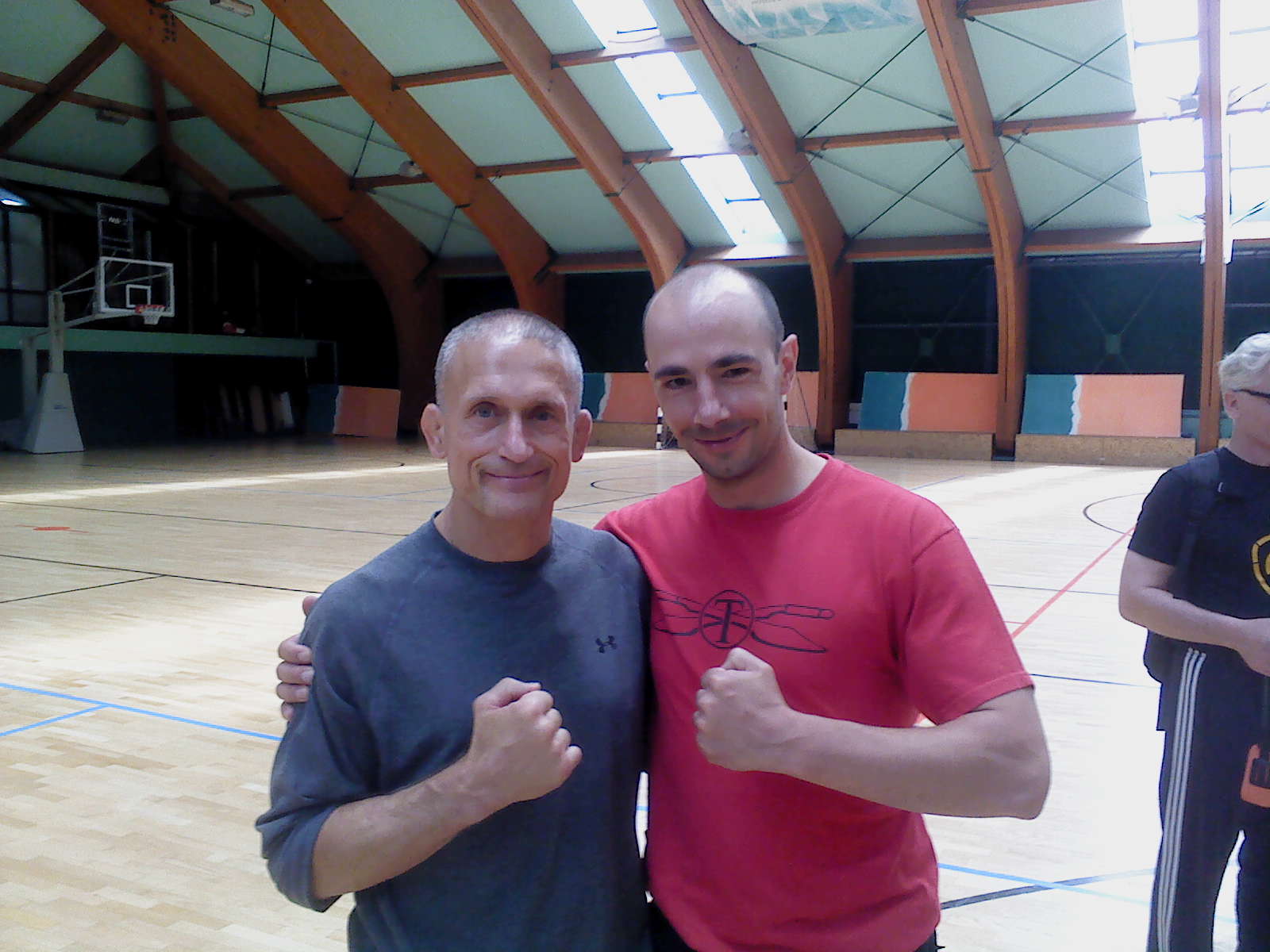
The man (on the left) and the wannabe (on the right)
During those few days, I was further impressed with Steve’s openness and willingness to share, both teaching and learning. A man of 60 years of age, in the physical conditions that puts most 20-year olds to shame, with half a century of training experience and yet, so eager to learn more and new things – even if you learn nothing (highly unlikely), you will be inspired and highly motivated to engage in vigorous physical training.

In conclusion, if you ever have the opportunity to take part in a seminar conducted by Steven Maxwell, do yourself a favor and do it.

Training above the clouds, Mt. Kopaonik, Serbia

This was my 10th time attending this event, and while each and every one was great, this one was special for several reasons. Certainly one of that stood out was the presence and instructional contribution of the guest instructor from Russia, Dmitriy Khakimov. Not too fond of formalities and ego-boosting titles, he insisted on being called Dima, and he came to fill in for his own teacher Andrey Gruntovski, who unfortunately had to undergo a surgery so was unable to come himself.

However, the master certainly knew whom he was sending, as Dima was the absolute hit of this year’s training camp! The school/style he represents is known as Skobar, and it is hard to imagine a better presentation than the one we witnessed for two days. It was very easy to see the direct and true lineage to traditional Russian folk approach to fighting. There many schools of RMA today, claiming lineage that dates back hundreds of years, but with suspiciously modern way of moving and methods of training.

Not so with Skobar. Those in the attendance were able to see and try for themselves the warmups and preparatory moves from folk dances, whipping strikes, pendulum-like body movement, unique footwork designed to work on ice, waved mode of power generation etc. Dima is a phenomenal instructor with excellent sense of measure – he was able to sensibly monitor the mood of the class and switch skillfully from one mode of work to another, thus keeping the trainees motivated, alert and attentive. The material to be taught was chosen adequately, demonstrated and analyzed with care and good pointers, while highlighting the bigger picture and historical context it fits into. 

Dima - small in stature, but a great guy
Like all the other instructors mentioned, Khakimov is an absolute charmer. Always ready to help, join or start the fun, be it singing, dancing, extracurricular stick sparring or having a drink…too bad he was only able to stay for two days. Still, the impression he made was so strong that everybody was left wanting more. That said – stay tuned, we may just as well provide ;-)

Alex Kostic has been the host and the guiding force of this event for years, providing innovative training, brilliant insights and highly motivational environment to train in. This time, it was no different. His take on the mechanics of kicking efficiency and punching effectiveness is ever evolving and improving, so the students always get away with a lot to work and ponder upon after the class. The teaching methodology of Homo Ludens has once again proved successful by seeing almost immediate results even with the people who came to train with close to zero previous training experience.

Alex, the ever evolving martial artist
One of the guys who for sure represent the future of functional martial arts in Serbia, and with bright future before himself, is Stefan Bozic. As talented as they come, hard working and meticulous in his training, Stefan is a true MMA prodigy both as a fighter and instructor. We had the pleasure of learning his approach to the fundamentals of ground grappling, with strong accent on proper body mechanics of moving on the ground, positional control and escapes. Training in the great outdoors can be at the same time humbling and rewarding experience, and it was the case with this session. For the last 15 minutes or so, yours truly provides some insights on the applications of the covered material when having to deal with potentially knife wielding opponent in a ground grappling situation, or being the one trying to deploy the knife when being caught in an inferior position. At the end, everybody was tired but satisfied for testing and feeling on their own the strength of the instruction they had received.

True ground fighting with Stefan
On the last day of the camp, I had the privilege of being asked by Alex to share some of my insights and teach the progression of empty handed defenses against an attacker armed with a knife. Everything I showed was basically a distillation, and sometimes direct application of the things I had learned from my teachers, so there is really no big deal about it. Possibly my “biggest” contribution is the ability to explain the techniques and methods in various ways (most probably the dividends of working as a school teacher for a few years), hence presenting the material to suit the individual learning modes of different trainees. After all, my approach is such that the participants are offered certain guidelines, following basic principles, and then made to play with and discover on their own the strengths and weaknesses of various technical and tactical possibilities. It allows for the dynamic training and quick assessment of the subject matter that was tackled.

In conclusion, I would like to express my heartfelt gratitude to everyone who made this experience possible and as great as it was, including Milan Jerinic for being a great friend and roommate – but special appreciation, beyond words, goes to my beloved wife Mira, without whose understanding and willingness to keep up with my maddening obsession training my life simply would not be even close to being good as it is. 


Monday, May 28, 2012

Are you experienced?


There has been something going around in my head over the past couple of weeks…and it sort of became “materialized” last weekend. A friend of mine Milan Jerinic and I conducted a seminar on some of the fighting principles and methodologies of the Homo Ludens system of martial arts. Like always, the emphasis of out approach is having the attendants experience the material taught and develop as much as possible, and as early as possible, the corporal understanding of the principles and material presented.


While I would say we had some success in attaining this goal, there was one thing that crept up during the work. Experiencing…well, along with all the good things that come with it, there seem to be some downsides too. In short, while it is good to be able and say that one can claim from the personal experience that something does work in real time, there appears to be an inclination of experienced solutions to a problem to become somewhat “dogmatic”. In other words, once a person manages to apply a technique or a movement in real time and under pressure, they tend to start thinking of it as the only solution to that type of problem/task at hand.

Specifically, during the seminar segment that I dedicated to learning about weapons use (particularly in the symmetrical manner), the earlier presented and adopted methods kept showing up even during the drills that were explicitly instructed to use other methods. In the future I will try adding more asymmetrical situations in between the symmetrical ones, in hope of keeping it up bit more “chaotic”, thus requiring departure from singular interpretations.

However, this whole experience (hmmm) led me to thinking about something else – how many methods, drills, techniques etc. have been dropped from training (especially in the so-called RBSD camps) simply because the instructor(s) never came to trying them, owing to the fact that they had tried, and were successful, with something else?

Of course, the reality-based cluster is not the only one succumbing to this occurrence. We have all witnessed techniques that had been discarded as “useless” re-occur in MMA occasionally and with stunning effect. 

Winners!

Some of them have since become widely accepted (eg. high roundhouse kick), while other ones not really (eg. spinning backfist or that Machida-jumping front kick). Could those actually become “normal” or high-percentage if practiced with more dedication and open-mindedness?

Losers?

Even in the systems that declaratively do not have pre-defined techniques (most notably Systema), you will see people reverting back to some favorite answers to the tasks that bear some resemblance. I know, they will say it is due to universal principles that apply “across the board”, but that does not change the fact that they use the same expression of the given principle over and over again.

The question then is when to reach beyond and try new things? How much training in something is enough to try it in a dynamic environment and conclude with some degree of certainty that it is functional or not?

Of course, there will always be the inevitable interference of fluke and lucky shots…but how to recognize and tell it apart from the reliable high-percentage options?

This gets me to the clever words of my friend Noah Gross, referring to how they do things in A.C.T. (Armed Combat and Tactics. If you are unfamiliar with these guys, you would be well-advised to check out their work – a superb group of people that are both brilliant fighters and genuine gentlemen). In Noah’s words: “The most important thing is to keep looking for ways of using old knowledge in a dynamic training environment. You spar and survive – you get experience. You learn a technique – you try to implement it. You didn’t – you go back to the drawing board and look for the why's and the if's and the how's…Bottom up + top down. Knowledge meets experience…

Noah Gross and Alexander Zhelezniak of A.C.T.

Time to go back to the drawing board I guess…

Thursday, May 10, 2012

Curriculum in Russian martial arts - our take


My friend Paul Genge, a RMA instructor from UK, has recently written about the place and role of curriculum in training this type of combat methods, and what shape it should take. (For Paul’s very good and insightful article, go here: http://combatlab.russianmartialart.org.uk/blog.asp?blogid=2 )
This post is my attempt at offering some guidelines in that regard. It needs to be clear right away, that the following methodology of teaching and training in RMA is not my own breakthrough, but rather the accumulation of knowledge and experience that has been embodied into what is now known as HomoLudens approach to martial arts, coming from the instructors in the club Vukovi (Wolves), with whom I have had the pleasure and privilege to work.

The first thing should be sorted out is what is the main focus of teaching? Is it on passing some specific body of knowledge in a more or less intact form, or is it making the students, as individuals, capable to express a degree of fighting competence in their own performance, and naturally, with their own individual style. We happen to be inclined towards the latter, which in turn dictates certain “progression”, or maybe it is better said hierarchy of things. The first issue is somewhat based in our integrity as a club – we teach what we believe the student NEEDS to know, not what they WANT to know! So far, it has pushed away many a Specnaz wannabe and Youtube “warrior”, who were focused on the image of things, over the substance. While maybe not the best business policy, the Wolves refuse to be feeding people’s illusions for mere monetary profit, and instead we offer an honest and authentic environment to train in.

HomoLudens club Vukovi

OK, so what is it that a student of (Russian) martial art needs? I guess there are as many answers to this question as there are instructors. The viewpoint also plays a significant role here – is it dealing with common types of attacks; mastering some “high percentage, surefire” techniques; having ready-made answers to wide variety of problems etc.

Our starting point is the bodily ability to deal with certain physical realities, pertaining to combat. Yes, those are many, but some fundamental ones are: free movement in space, comfort in any plane and any level of movement (standing, kneeling, squatting, sitting, laying and anything in between), handling the force of the opponent, issuing force of our own, emotional composure in dealing with all of the above.

Now that the needs have been identified, one can work on learning about the best way to execute those movements, i.e. the proper mechanics of delivery, and then honing and polishing them. Here we come to a couple more important points to cover. One is that our teaching, like in most other RMA schools, is based on the emphasis of principles over prescribed techniques. That does not mean, of course, that techniques are unimportant and irrelevant, far from it. Everybody needs techniques that best illustrate the principles that form the core of a training method…however, a technique is but one possible expression of a principle and should be taken as such. Therefore, the drills are meant to instill the command of a principle, not to build the “automatism” of a technique. It means that as soon as the student gets a grasp over the principle, he is exposed to the dynamic, fuzzy type of drilling, where his technical expression will have to adapt “on the go”, in effort to properly respond to the demands of the situation.

Think of it as the conversational scenario when taking a course of a foreign language. You do not practice your grammar by “drilling” the same sentence over and over…at least I hope you don’t.

Speaking fluently?

What you take a look at it, there is a sort of dichotomy here – on one side you need to develop good and efficient mechanics of delivery; on the other you need to be able of adjust it to the context at hand. The former focuses on technical precision, the latter on the emotional composure that enables the adaptation. How do we put the two together?

This is where the great insight of HomoLudens founder Alex Kostic comes in handy again, i.e. his formula of symmetrical and asymmetrical “work” in fighting. I have already discussed this distinction before, so let me go straight to how it applies here. We use the symmetrical approach to developing and refining the mechanical efficiency and technical precision, while the asymmetrical work is employed in enhancing the contextual adaptability, along with its emotional/mental component.

Alex Kostic

If we are to get back to that language learning metaphor, the symmetrical approach is building your vocabulary and grammar, the asymmetrical is becoming conversational – thinking in a foreign language, without the need to translate every single sentence in your head.


Friday, April 20, 2012

DVD review - Greg Mihovich training instructionals


My previous post/rant was about doing some complementary fitness training along with your martial art activity. However, in order to avoid becoming a muscle-bound brute, you need a good training regimen, and in the following review I would like to present an excellent option.

Let me say from the start – I have absolutely nothing about training with standard weights (barbells and/or dumbbells) and doing it within the environment of a standard gym, as long as you know what you are doing. However, for some reason (actually, quite a few of them) I have always gravitated to other forms of conditioning and physical training, bodyweight being my preferred mode of operation here. (Nevertheless, revisit my post about the Torqueblade Torsion Training to see some other things I enjoy in this regard).

I do not remember exactly how and when did I first hear of coach Greg Mihovich, but at one point his name started popping out rather frequently in my inquiries about various functional training methods for martial arts, so I looked for a bit more info on his background. To cut the story short, the following article pretty much convinced me to contact him and try some of his stuff:

    
Greg Mihovich
 
The two of us sort of hit it off immediately (may have something to do with our Slavic ethnic background), his approach made a lot of sense, and I decided to invest some time in following his training guidelines. To that end, I ordered three of his products, which are reviewed here.

Primal Conditioning 1

While I thought for a moment that the description reading “Definitive guide to complete body mastery” was on a cheesy side of things, even after the first “run through” overview of the package had me in different mood. Actually, in the context of strength training, the only thing that could get you closer to that goal would be joining the nearest gymnastics club… Still, if you’re not in your early teens (like I most certainly am not), even that might not be the right answer.
Anyway, the first thing that really resounded with me immediately, when it comes to Greg’s Compound Conditioning is his emphasis on movement, over the isolation of body parts/muscles. If your are looking to improve the level or performance in your chosen activity, instead of going for the esthetic appearance, this certainly makes a lot of sense.

In order to cover as much ground as possible, Mihovich differentiates between several basic human movements: squatting, pushing, pulling, bending, extending, rotating; and when it comes to treating the core of the body, he works it both its stabilizing and movement initiator roles.

So in this 2-DVD set, we get to see eight categories of exercises: squatting, pressing, bridging, pulling, flexing, rotational, plank and what he calls the upside-down group. Demonstrated in each group are several exercises and their variations of different degrees of difficulty. Coach Mihovich gives some very good pointers regarding the proper technique in doing each exercises, and some of that advice has improved my performance almost immediately. That said, I really like the balance of his verbal explanations – not so verbose to bore you, yet detailed enough to cover all the important aspects.

Now, we come to another feature of Greg’s instructional training products. The DVDs themselves are used to offer a sort of thesaurus-like format. It means there is a chapter dedicated to each of the exercise (sub)groups, so you can find them easily. His explanation of basic program making and exercise selection, along with sample workouts is offered in the accompanying booklet/manual. It is by no means extensive, but covers all the bases you need, including the sample routines for the basic, intermediate and advanced level. The rationale behind those is touched upon as well, thus making it pretty well-rounded.

There is enough material here to keep you working for a long time, especially if you also do some “scull sweating” and use the presented exercises and training principles to compose your own programs after going through all the samples offered in the brochure.

The only question I was left with is how come more people are not using this format in their instructional packages? 


Iron Beast Conditioning

This one deals with the use of kettlebells in physical fitness training. Just like the “Primal Conditioning, it comes as a package of videos (3 DVDs!) and a manual (at 25 pages of information, pretty good one too). 


In line with the nature of the beast, coach Mihovich divides the entire material into two big categories – grinds and ballistics, and then has them further subdivided into basic movement or skill groups (yes, you’re wielding an external object/force here, so there is some skill involved in doing it properly).

Being a good and responsible coach that he is, Greg opens up with a chapter on preliminary skills and exercises and safety tips. Try not to skip those if you are not already a veteran kettlebell swinger (just could not resist that one:-))

The manual starts with a list and comments on some universal training principles and guidelines one should consider if they are training for performance. Now, this is neither exhaustive in the number of principles mentioned, nor in-depth in the coverage of those that are, but will point you in the right direction to research.

Without the detailed overview, the exercise categories demonstrated are:
I. Grinds: - squatting
            - pressing
            - rotational
            - bending
            - pulling
            - flexing
            - mixed group

II. Ballistics: - pulls (swing, clean…)
-         presses

III. Combination lifts

The booklet also outlines the sample training programs for the novice, intermediate and advanced, and the latter two include full and abbreviated options. However, there is also the program for those who would like to get more specific and try the kettelbell sport program, and that one is three phases (four weeks each); and finally the fat loss program if that is what you’re after.

Again, a brilliant package.


Amazing Mobility

Of course, if you only focus on strength and over-emphasize that aspect of the fitness training, you may risk becoming bit stiff. In order to prevent that you should take up some mobility and stretching regimen, so this DVD covers that for you.


The exercises in this one are not revolutionary, but they are presented in a nice manner and in the order that makes much more sense for your body that simply jumping all over the place in a random fashion. Greg treats all the joints and body parts with care, making sure that there are no holes in your overall plan.

That said, we all do have different problematic areas, and you should be honest with yourself here. Unlike the case of strength programs, which are more easy to quantify (via the number of sets and reps), the mobility is concerned with the quality and range of your motion. In practice it means you should focus on and do more of the things that are difficult and uncomfortable, instead of dwelling on the exercises that are easy, comfortable and make you look good.

In this video (and a booklet of course) we are shown mostly the set of exercises done in the standing position (although there is a bonus chapter on the DVD with some more “grounded” exercises), and the brochure discusses how you can use it as part of your warm up before other training, as means of active recovery or as part of what is called the morning recharge routine.


Through my communication with coach Mihovich, I found that he also has a program of ground mobility exercises. What’s even more important, I had the privilege of seeing it and hope that one will also find its way to the general public in another excellent training package like the ones reviewed here.

Finally, you can contact Greg and order these products through his website:
http://undergroundgym.com/